Watching Director’s Bong Joon-ho‘s Parasite: Symbolic Fantasy, Horror, Class and the Excremental Vision. Seen 26/02/20.
Beware: you may consider this to contain spoilers.
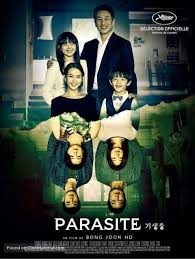
This film is self-evidently worthy of its accolades and, perhaps, of even more than it got – the acting was finer than any, maybe outside Joker, in any US film of the Oscar year in which the former got best picture but not acting awards. But the triumph lies in the use of visual symbolism.
From the first we see the camera pan down from a partitioned window, before which small laundry hangs down, towards the room level below. We notice as we go down that that window is at floor level of this basement flat. The high-level window, in such a low place, becomes an access point for the worst of the refuse of the city, including the urine of passing drunks who pee against it, the gas used to kill parasites infesting the city’s rooms (‘leave the window open’ shouts Dad, happy to get his home’s parasites killed off for free) and even the sewage water which floods the low ground of the city after the heaviest of rain. Living in a basement is the economic necessity facing the Kim family. Luxury in the film is a high hill-top site, approached by stairs going up not down and whose basement-bunker, a secret place from the family who live there, is despite flights of descent to its base, nevertheless free from floodwater at all times.
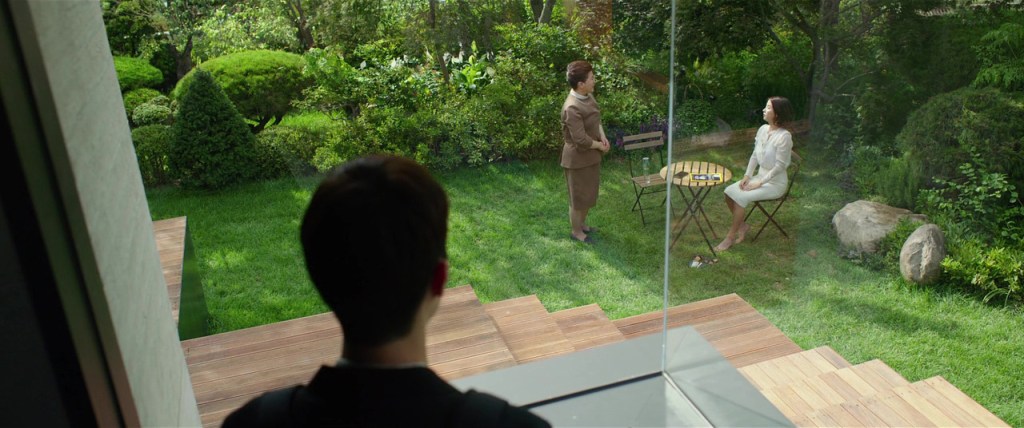
Hence camera-angles are important here. Looking up or down, walking up and down stairs can be statements of desire or fear that are wrapped up in the class system. The youngest Kim boy’s aspirations are revealed by a shot, as if from his viewpoint. from a window ‘looking down’ on the rich family he has just been hired by.
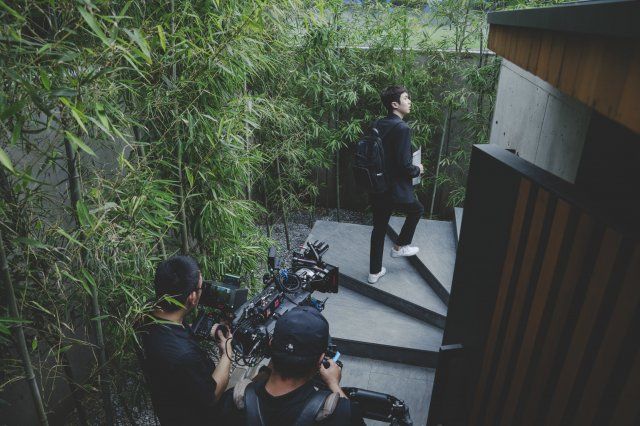
Stairs are descended to get to the part of the city lived in by the Kims, stairs that became angry waterfalls in the rains punishing those already lowered in the eyes of a class-bound society.
Ascents and descents are, as Mark Kermode hinted in his Guardian review very much about class. However symbols are never just about one idea and often they express other kinds of desire – such as wishes, either for aspiration or degradation. Enter the man who, having been locked in the secret bunker of the Parks’ house (unknown to them) has focused his desire (which he calls ‘respect’) on the man of the house, lighting his ascent through the house from push buttons in his own domain, allowing Mr Parks the belief that his house has automatic lighting as he ascends its well-planned levels of open accommodation. Respect involves a love of one’s own literal lowliness and servility here to the point of inescapable madness. And Mr Parks neither knows that this man exists nor that he exists in layers underneath his house, of which he is unaware or unconscious. This level of the unconscious will cost dearly once negligently liberated.
Descents recall those of the desirous fear in horror movies, especially in the set for the bunker-basement, although they also afford sick humour also as we applaud people falling down them – the audience rocks with laughter when an old lady falls down some of these stairs so violently, and deliberately comically, that her body lies broken below, allowing her only momentary time to try and bite off the bonds that hold her gagged husband against a water pipe.
And these lower levels if they are about class are also about the levels of behaviour and recordable life that constitute the depths of the unrecorded. here is where excrement makes its entry – sometimes violently ascending through portals which we think of as one way and call toilets. At the lowest level, sewage doesn’t drop away from our site but explodes upwards back into living spaces in some of the most unpleasant, but funny, scenes of the film.
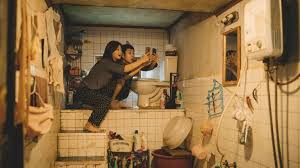
The toilet of the Kims is at a higher level than their living rooms in the basement such that their bathroom has steps to it. we see the children utilising that to get free Wi-Fi from that one place, behind the toilet, that it is accessible. These downstairs room have restricted access and are spatially limited. They contrast with bourgeois open living that is far from truly open as its aesthetic of chiaroscuro (see below) seems to tell us in visuals alone.
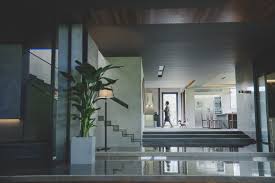
The unconsciousness of our own excrement marks the importance in Freud of that point at which humanity evolved fully from an animal on all fours for which the excremental was merely a part of life. We replaced the ways in which animals expressed in part the emergence of desire by smelling the anus of a possible partner by a disgust response which rendered the excremental not only a set of activities done privately but also never referenced. This film reverses all this. It has the smell of the, in the eyes and nose of the developed middle classes, lower classes shut away, fine as long as it does not, as Mr Parks warns, cross a line between them and him. Hence smell and the consciousness of smelling and being smelled by another does make up quite a number of ways in which this film tells a story.
Discussing the smell of those who travel by the Underground Metro, which Mrs Parks having a chauffeur never uses, is done by the Parks (having rather distant clothed sex at the same time) has Mr Parks say that Mr Kim’s smell crosses the line between the front and back of his chauffeured Luxury car. This conversation happens whilst the very lower classes (the Kim family in toto) are hiding unseen under their table – a table we last saw as a rather roughed up working-class dining surface. That scene is recalled without words minutes later when, on the next day, Mrs Parks is chauffeured by Kim and each silently by discrete but beautiful visual signs, unseen by each other, become conscious that Mr Kim does indeed smell.

Of course we also know that Mr Kim spent the intervening night wading through sewer water in the basement that is his home. The link between small and ordure is thus made very firmly but without words – a very great theatrical skill.
If ordure is important so are suppressed emissions from coughs particularly blood and the pathway to the film towards the freer flow of blood in its denouement is telling. Mr Parks rejection of the blood of those lesser than he is expressed in his nasal response to flowing blood. It is an important turning point in the novel that sniffy class-bound response to what is seen and smelt as lowly, less than the dignity of the bourgeoisie deserves. Food and modes of eating also have an important function – appearing as a commodity, necessity and as a luxury. The Kim family’s ‘fortune’ prior to this being dependent on making up (badly) boxes to feed a market for cheap high-street food.
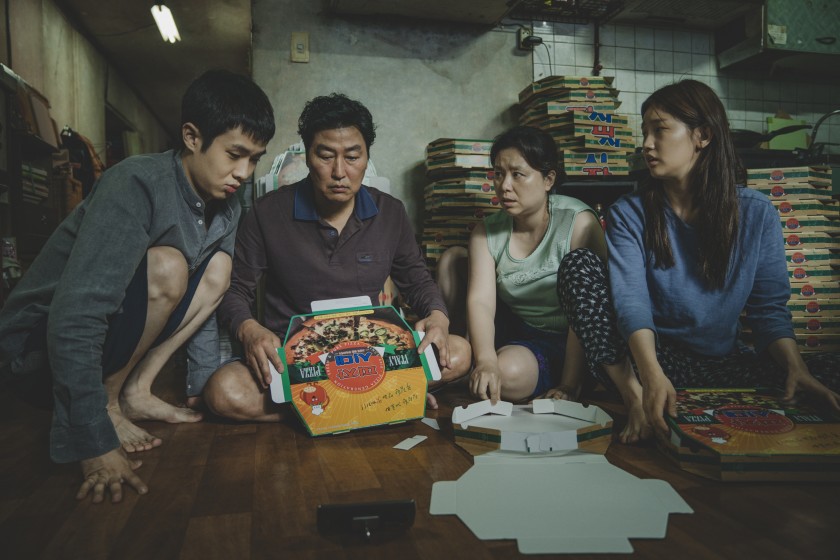
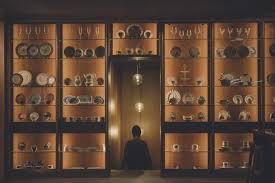
The desire to rise is mirrored of course by the desire to lower oneself but the latter is deeply repressed, expressed in images of hiding, of the fascinating of doors to a lower level, of a secret unacknowledged lover for the Park’s daughter or ‘the primitive’, as the native American becomes for the youngest Park child. Doors which get locked shut to hidden depths access the unconscious but very much in the shape of solid symbols – a hidden life, driven to basics like the ‘madman’ in the bunker because it cannot itself be respected and loved, feeding parasitically off one that is all show and appearance. Ghosts of our repressed consciousness appear at such intriguing doors to a downstairs behind the façade of our luxury-marked domesticity.
This is a great film. I hope I haven’t put you off.
Steve
 Steve_Bamlett_blog