Reflecting on the author talk at Forum Books, Corbridge 18th February 2020, 7p.m.: Deepa Anappara (2020) Djinn Patrol on the Purple Line London, Chatto & Windus. Link to pre-talk reflections on reading novel itself here.
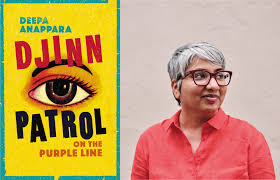
This was an exciting evening, not least because the author spoke of a new historical novel in preparation. For more though, we must wait.
From the many short readings I jotted down many hitherto hitherto undiscovered resonances. In the reality of modern India it is likely that there are 175 real child disappearances a day in India, the author revealed from her journalistic work. In this light the following phrase from the novel stuck out and it is typical of the novel’s underplayed mastery. As Jai’s parents discuss other’s response to the first child disappearance in the novel the note someone selling charms and myths. Jai’s father says: ‘He makes money out of other people’s misery.’ (Anappara 2020:56).
Now this seemed crucial in the novel and true at so many levels of the actions of characters in the novel but also of the human hunger for misery stories that make them into desirable commodity forms – as journalism or even novels. The complexity of the moral issues emerge here.
Asked at the end of the session whether she is a political novelist, Anappara said something likeThis. She noted that writing courses in the West often teach novelists to despise the political as a function of the novel. However, her origins in Kerala, with its socialist tradition – the remnants of which linger – made it that ‘she could not afford not to be’. This is not because of any tradition alone but because political realities of the fact of inequality and its consequences are so apparent in Southern India. ‘We don’t have that privilege’, she said of the option of being a non-political artist. Indeed she was to find the same in Northern India.
Deepa Anappara fills no-one’s stereotype of a ‘political novelist’ but her reading recommendation of the great Rohinton Mistry’s A Finer Balance, plus Michael Oondatje and Toni Morrison, suggests the tradition of political writing is one that uses aesthetic filters, where politics speaks from beneath the symbols thrown up by everyday life like smog and basti communities. I would have liked to know more of her response to a question asked about Arundhati Roy.
Speaking of the need of distance – through humour and the deflecting power of a naïve child’s viewpoint she showed, if not discoursed upon, how political thought might arise through facing facts too horrible to be openly displayed. The latter option is like meat displayed on the stalls of the novel’s bazaar. The child sexual exploitation in the Bahadur story can be missed in the half-knowledge of the fear of its potential, and perhaps, actual, victim. This described by the chair of the event as a kind of ‘double understanding’ where unspeakable fear of real exploitation underlies naïve understandings of it.
There is much more that can be said of the evening but its beauty, as a performance, couldn’t be conveyed. The joy of one woman in the audience for the novel she had read was itself a treasure
What is clear is the Forum Books is an excellent resource for the North. I could only want much more. Helen – you are a hero and a person who uses her past links to London literary culture to open up understanding in the North on a daily basis.
NOTE: One correction of my earlier piece – https://stevebamlett.home.blog/2020/02/18/reflecting-on-a-debut-novel-by-deepa-anappara-2020-djinn-patrol-on-the-purple-line-london-chatto-windus/ – unread though it certainly will be – is that city of smog is not named as Delhi, as I sort of hint in a caption. It is not named at all because that smog-bound city of the novel lives everywhere in modern India. It is protective moreover not to name a city since Jai and other children are composites of real children whose stories were told to Deepa and whose pain lives on too much to endanger them by identification.
Steve
 Steve_Bamlett_blog
One thought on “Reflecting on the author talk at Forum Books, Corbridge 18th February 2020, 7p.m.: Deepa Anappara (2020) ‘Djinn Patrol on the Purple Line’”