Reflecting on a study day based on Mikhail Karikis’ exhibition, For Many Voices, held at Middlesbrough Institute of Modern Art (MIMA), part of Teesside University. @mimauseful (some phrases from the MIMA description are lifted here to ease the typing project). Further information in links.
MIMA has a good record of bringing artists and academics together to discuss and, perhaps more importantly, perform ways of understanding the collaborations needed to both explore and enact art as a politics; a means of performing social change through multidisciplinary acts of the arts and sciences. See for instance one I also attended. https://stevebamlett.home.blog/2019/07/20/mima-on-berger-shaping-contemporary-local-higher-education-without-the-constraints-of-the-faculty/
For Many Voices illustrates as an exhibition, and a study day topic, Karikis’ (now a Professor of Teesside University) long commitment to the voices of those who may be unheard, unseen and structurally neglected in society. His work, made across ten years, included two pieces commissioned by MIMA:
- No Ordinary Protest (2018), co-commissioned with Whitechapel Gallery, and;
- Becoming Insect (2019) in which the same Tower Hamlets’ primary school children worked on how and why we might imagine the need for human beings to become a bee in order to substitute for the depletion of the insect world and its functions in human-made climate crises.
The collaborations between the academy and the arts institutions, including creative curation and exhibition venues and spaces, is of course then only a small part of the collaborative project which make up this art. The study day then was only the tip of a discursive iceberg where discourse will include not only articulate reasoned academic discourse, or even articulation at any ‘level’ of sound or marks on a page as words or ‘logos’, but also sound and noise, percussive initiations of sound-waves or the visual and sound notion of ‘noise’ in which the hum and cacophony of the conflictual world is heard and seen.
However, such ideas do need articulate expression – whether through a multidisciplinary cultural and socio-political and feminist lens like that of Ella Finer or the philosophical phenomenology of another artist/academic Salomé Voegelin. Both have a history of work with, about or in parallel with Karikis. Both are major artists who choose to work collaboratively. You can, for instance, read Voegelin’s really illuminating text on one of Karikis’ works, ‘I Hear You’.
Karikis spoke, in answer to questions during the day, of the profound effect on his art in working with people in whom the issue of protest from a position of marginalisation where he nature of sound was crucial. This included the teaching of gendered sound in ‘gender-reassignment’, wherein he gauged the world of preoperative transsexual women through their training in the gendering of sound. Further he worked with neurodiverse people who had no ‘articulate’ (i.e. verbal communication) while possessing vocality without doubt. He also worked with displaced working-class mining groups especially those involved in producing music in bands or choirs, notably with ex-miners from Kent in Sounds from Beneath (2011-12).

In the latter, he filmed in one of the many black holes in the Kent landscape as sen from aerial views, which turned out to be non-rehabilitated ex-mining landscapes. Choric formations of men (think of Greek tragedy here too) form and deform visually and vocally. They mouth sounds they remember from their underground work – words like ‘coalface’ but also the sound of cutting technology, the creaking of the earth above.
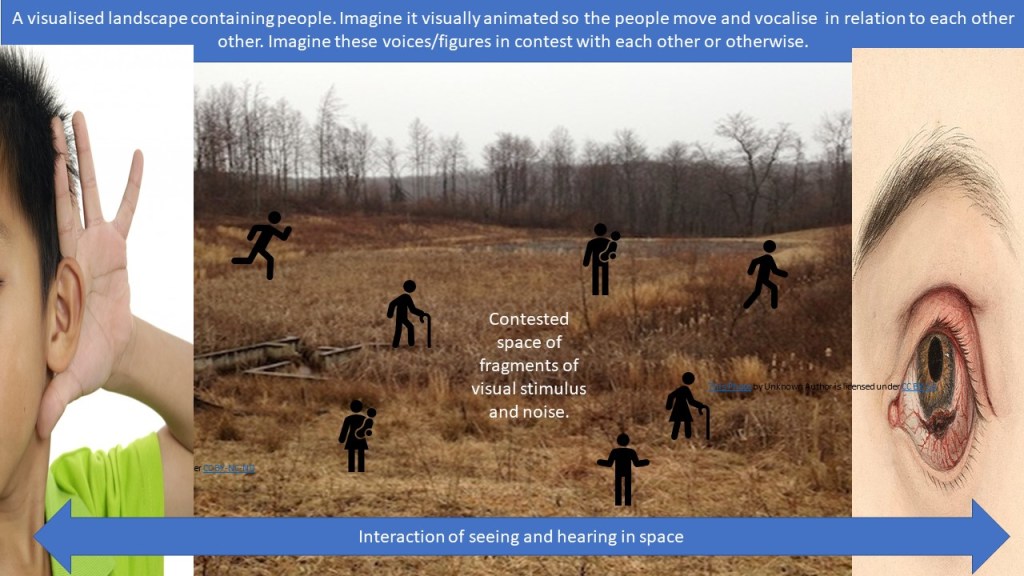
The study day opened and before the exhibition tour led by Karikis by Ella Finer’s revised version of a paper she delivered at the Whitechapel Gallery, on Karikis’ No Ordinary Protest, which was played first in its full 7 minutes. Mikhail himself described his project in a way that emerged in my notes something like this graphic, if hand-drawn there but using externally sourced graphical images here.
Finer’s rich analysis focused at the end on how a multi-ethnic primary school children in the London borough of Tower Hamlets collaborated with Mikhail to interrogate Ted Hughes’ text The Iron Woman. His film distanced itself from one of the text’s main tropes. In that text the noise of affect (feeling) and cognition (thought) mix in the eponymous woman’s emotive unfocused disquiet only to give way to ‘rationalisation’ by a male voice at the end. The children bring ‘she’ back into the centre of our attention as feminist discourse might do, suggests Finer.
Finer argued that the film rescues the voices of emotive protest for the children in empathy with the iron woman and disregards attempts to articulate a message of ecological resistance in male terms. Thus what we get are strong associations with between the ways the children link ecological disaster as an affect occurring in audio-visual space: noise (visual or aural, resonance in analogue waves or digital buffering) -> information -> disease.
In the space of the children’s protest, information no longer informs or shapes from within an argument about ecological crisis (‘in’ –‘formation’) and is felt as disquiet, nausea or disease where figures and spaces infect as well as affect and effect each other. What we feel is the urgency of the issue.
Hence what is felt as destructive of form in this film, like the dance of salt on a surface put into sound vibration, can also be seen as transformative or metamorphic – as a way of leaving us in the awareness of a diseased ecology and organic-ism to (what I’d like to call) a state of not being at comfortable ease; in fact being in dis – ease).
Of course I’m mixing here Finer’s, Karikis’ and my own metaphors in the muddled prose above. I take permission for this from the central message that all form is potentially emergent in expanding spaces of collaboration.
When Karikis commented on Finer’s message, he filled out some of the process by which the film was made – involving immersion in the children’s world for over 9 months, in which the class learned to take leadership as well as give it (the space having been sufficiently safeguarded from significant harm to the children).
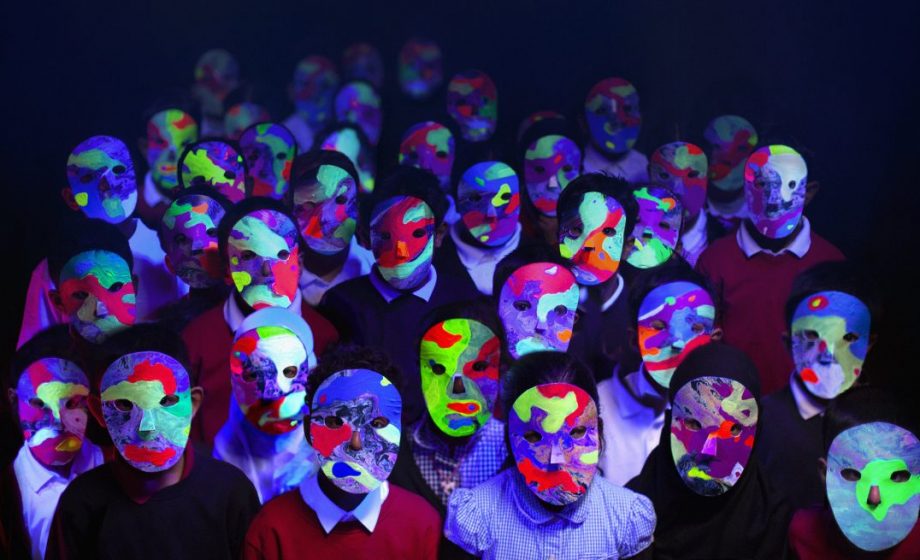
He pointed, for instance, to the dynamic semi-dance motion of masked children based on the children’s response to seeing footage of an oil spill in clean sea water and their provoked fascination with the production of toxic or diseased colouration. The masks they made used these toxic colours in overspill with each other – dancing / moving to sound in conditions of light that make the colours fluoresce. The still below is ineffective because it is still – both silent and without motion.
No Ordinary Protest was a highlight of the day but I don’t intend to say more. At the exhibition a paper on this and the works of the exhibition by Katerina Gregos will help any reader more and is available free and in which she says helpfully (p. 3) that the children are said to ‘employ sound to trigger change’. You can also access Karikis being interviewed about the work on the web.
The photograph below will help you see how space is curated in one part of the exhibition that we saw next, but do not expect the curation of space to be constant throughout. Space informs by variation as you move around the exhibition, allowing for different intermixtures of visual takes, including more fragmented ones than the one above, and noise boundaries, as the noise of one film emerges into another on our passage through the exhibition.

Salomé Voegelin was introduced after the tour by Karikis as a major collaborative influence on forming the phenomenological philosophy behind his art projects. He made it clear this philosophical perspective developed silently through his work until he saw how Voegelin’s descriptions fitted something that essential to his own work with otherwise marginalised collaborative voices and manifest images.
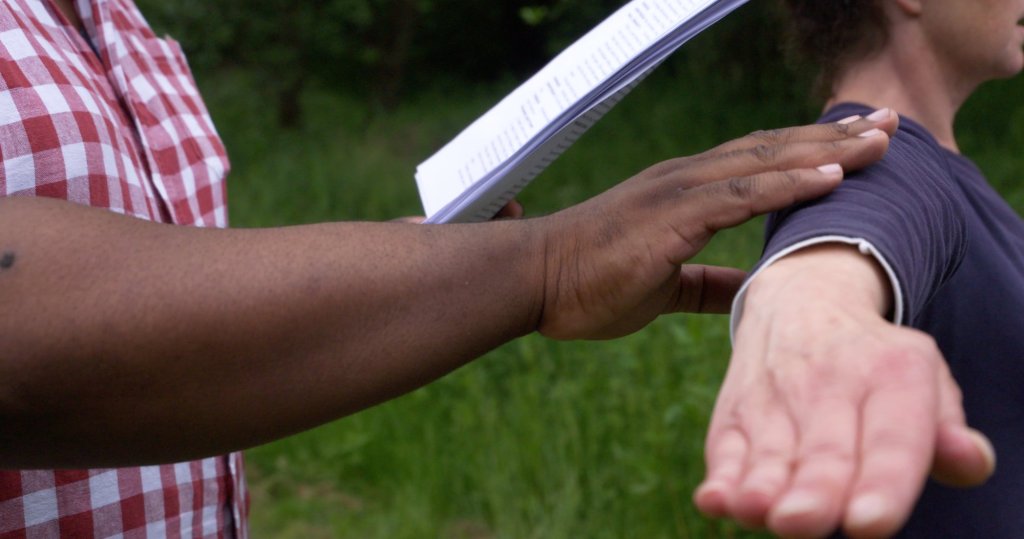
Voegelin then introduced the idea to us that art and all possible and impossible stories of communion between persons: be they dyads or a larger group are a product of complex interactions in space. She even illustrated this by getting the audience, where willing, to stand and interact through vocalised or body-percussive actions (hand-claps). We saw therein that such phenomena occur in the spaces between, say, an instrument that make sound (which could be as simple as a wall) and the embodied performance that improvises a audio-visual relationship to that instrument. For us that was the relationship of two people clapping hands together.
In the space between the agents lies the materials of the stories (or fabulations) which describe the event and is a place of inter-being. She illustrated that also in her own collaborative work with David Mollin – A Cartography of Knuckles and Fingertips (2018) in which the in-between spaces lying between knuckles, fingertips and what they interact with to make a complex sensory event are the space we try hopelessly to map.
That space can neither be measured nor captured as discrete data and is always excess to those conventional forms in literacy & numeracy that we use to describe the audio-visual-multi-sensory event.
Sound and vision together form transformative events that include the impossible in new fabulations of our inter-being. Inter-being can be heard and seen only by virtue of the inter-relation of everything pertinent to sense perception (including presumably touch as well) in the audible space.
If those two last sentences are not meaningful for you I haven’t this time managed to capture what the things I heard could mean for you. Perhaps I never will – but it isn’t, as the theory shows me, impossible – and were I to do, it would have meant we were both changed. I don’t then claim that the above is as an accurate description of her work. Voegelin has written widely. This writing represents merely how my first-time introduction to seeing and hearing her collaborate with others gained nascent meaning for me.
Her thought certainly has political consequences, as she stressed. Since walls are not ‘doable’ in the space of inter-being, a Mexican Wall or a concept based entirely on narrow boundaries like Brexit are unthinkable because not doable in space that must be audible space.
Sam Belinfante spoke next about the work generated in his role as Academic Fellow in Fine Art and Curatorial Practice and Director of the Centre for Audio Visual Experimentation (CAVE) at the University of Leeds. Sam spoke movingly about spatial art, curation and the role of the acronym CAVE as the speaking of a space where sense modalities are changed by the space and themselves change the space.
I had not remembered that I had seen Belinfante’s work, to my shame because I had enjoyed it immensely without quite linking it to a name, in the Yorkshire Sculpture Park – a work in which he performed, videoed and still-filmed ‘Bottom’s Dream’ to show the play therein of perceptual modalities in space. ‘I see a voice’ says Pyramus-Bottom at one point. He showed us one still of where a visually impersonated Wall is subjected to transgressive touch, sound and kinetic manipulation. Here was a strong image of the space of inter-being.
Mikhail returned at this point to allow people to begin to synthesise the exhibition and the various performances and discussions which by now had accumulated for all of us around it. He spoke of his journey as an artist as if originating from a place and space where he worked, as a young person, with people who were known to him – who thought and acted, as artists, creatives and thinkers, as he did. Its progression, still emergent, is to work in less safe and less predictable spaces of inter-being, as we might now call it. People who are not like ‘me’ with whom he now works productively and from whom he learns co-direction include, as we’ve seen Kent miners, children displaced from conventional futures in decaying post-industrial landscapes, neurodiverse and gender re-assigning people.

People who had an ‘extractive’ relation to nature particularly interested him in questioning ecological space – hence the miners. But the best example was the two films in one space showing the ‘seawomen’.
Gregos (p. 3) describes these as ‘female divers living on the volcanic South Korean island of Jeju in the North Pacific.’ Here a ‘seascape with depths from which to extract natural materials, but quite unlike a mine, was interpreted for these pearl-divers by a kind of song that was used to train their breathing, such that 20 metre sea-depths were manageable to them.
These and other sounds bring together place, space, visible figures in each other’s eyes and sound. I couldn’t (I have to admit) tear myself cognitively, sensuously and audibly from Bizet’s Pearl-Fisher’s Song, which went through my head to disturb further what I saw here, but SeaWomen is clearly a work that Karikis sees as fundamental to his artistic development.
It’s meanings need more thought but I was insufficiently able to see it on the day and I need to see it again before it leaves this MIMA space on the 23rd January 2020 – not long then!
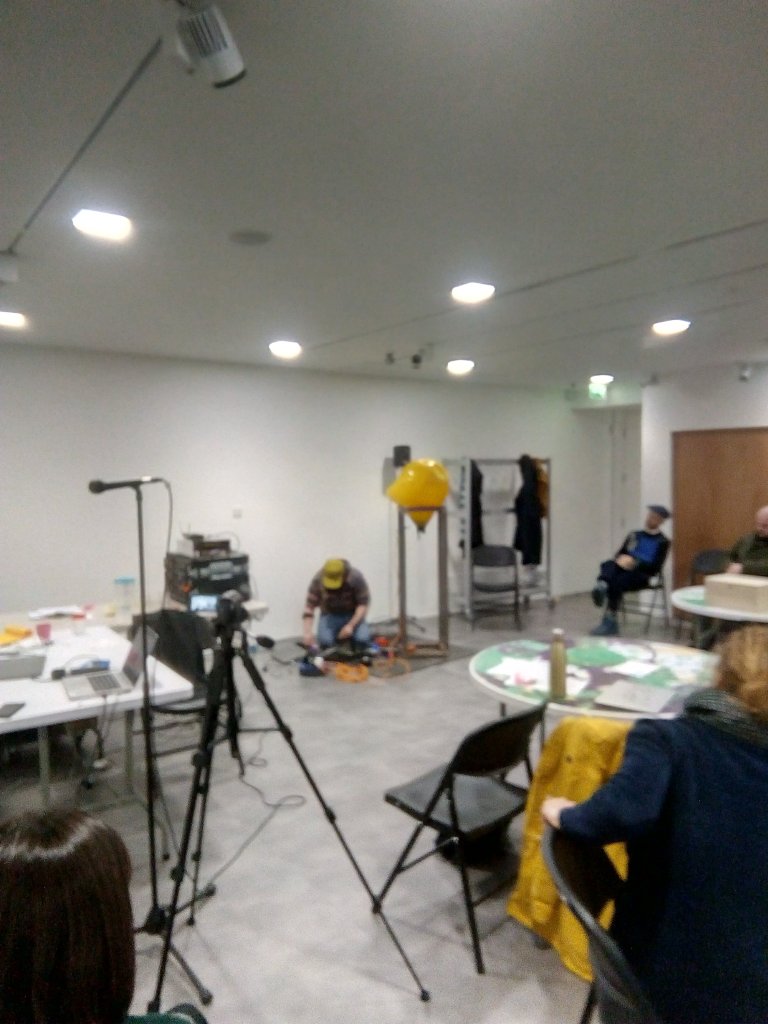
One might have thought the day might have ended there but Liam Slevin of the Art Weekender and Auxiliary Art Space in Middlesbrough had made an audio-visual assemblage, to hear which clearly corresponded to Karikis’ work and the ideas propounded in the day.

Whilst the stills above & below (my own now on Twitter) won’t help to see how space transforms through sound into a new kind of sculpture and/or architecture, they may whet your interest.
Enjoy the exhibition if you can see it before 23rd January.
Steve
 Steve_Bamlett_blog