Reflecting on Performing David Grieg’s Dr. Korczak’s Example based on a Leeds Playhouse performance, seen on the afternoon of 6th February 2020 (run 25 Jan – 15 Feb.).
CONTAINS SPOILERS
Who and what is involved in the performance of a play?
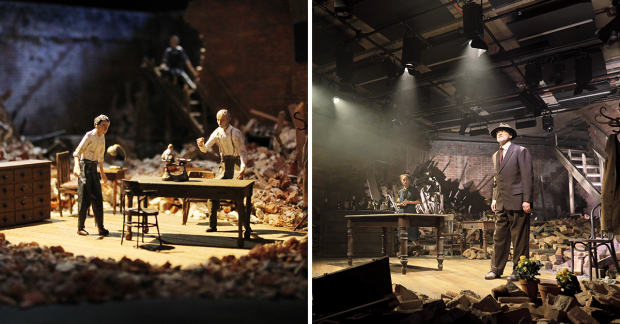
Our expectations of this production is in part formed by our knowledge – at least from the point of receiving the performance programme sheet before our descent to the basement theatre space, Brammal Rock Void, in which it plays – that its set was awarded the Linbury Prize for Stage Design.
The determinants of the acting space then are central and sets, especially this one, are in fact manipulations of very physical and perceptual space which form ideas of the depth, breadth, height and modularisation of that space. Because they concern perceptual space all these factors can be perceptually varied by effects of whole or partial scenic divisions, wall-painting, projected images and/or chiaroscuro.
One fine example of this is that audience’s’ experience of finding the theatre space, which involves descent of staircases, is replicated in the set itself in stairways that extend upwards to nowhere, including a Kandinsky-like diagonal stairway icon cast onto the a wall in the depth of a space at the rear of the stage or dominant playing area. The icon on this wall can in fact be seen in the designer Rose Revitt’s model box of the set, just as can the incomplete wooden stairway which ascends upwards to increasing signs of its structural purposelessness.
Words – and even 2D pictures – fail to convey some of the spatial effects achieved on a stage space itself but they can when actors stand silently still in them be completely haunting.
And then, this set of spaces is made even more complex and self-reflective in the use of simple properties , such as a set of drawers and two tables which themselves become performing spaces for the inanimate cast of dolls demanded in this play. Likewise three hitherto flower pots buried in the rubble representing the ghetto can be a window-box, garden or the natural garden of freer space the children most desire to find.
These dolls allow the three actors of the play to move in and out of different roles including that of narrators and also ensure that we are never allowed to make simple identifications with the feelings of these characters. For instance the character Adzio, played by the wonderful Danny Sykes, is asked to ready himself for medical examination by the Doctor by stripping to his underpants. Yet the act of stripping occurs by Sykes unclothing, not ‘himself’ but the torso only of one the dolls, a ragged one of less verisimilitude than the rest, which represents him.
Korczak here discovers the boys back is scarred by the wounds of heavy beating. We never see these wounds or even flesh – the point is not to experience the wounds as a realistic representation, which would paradoxically stress its unreality on stage, but to hear of them and the reason’s Adzio prefers to hide them in order to hang on to what dignity he can. Yet otherwise Adzio sees and names himself as a ‘fly’ evading the swatter. Painfully, the elimination of flies as a recognised pest chimes through the play in which Jewish children were forced by authority to take on the role of a pestilence to be exterminated. The play forces us to use the mimes in it of fly-killing to heighten its ironies without validating the horror implied in the analogy.
The role of dolls in performance will enable directors and stage designers to play games of scale. Characters often use dolls in order to create the effect of an encounter or interaction between cast members or to create a static scenario. This production chooses dolls which are small and easily set aside. Again the effect is to play out the disposability with which the real characters must come to identify. This is captured in the still below (from a perspective no actual audience member could have of course had had) of Stepanie played heart-rendingly by Gemma Barnett.
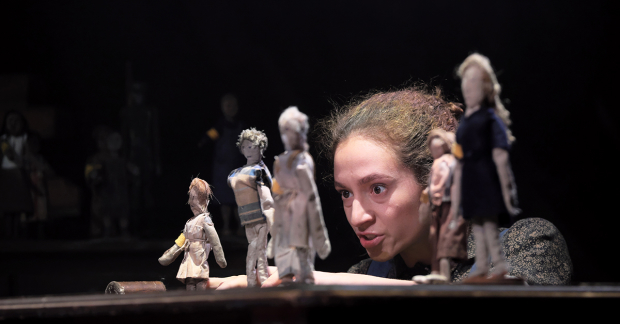
The use of bodily gesture, kinetic dynamism and facial expression in performance of human emotion becomes almost ironic when seeing the clear contrast of scale and relative detail between actor and the stillness of the dolls. Figures both animate and inanimate all come into interaction, even at the level of the meanings produced by this play. Thus the naive human tendency to see empathy as natural and universal is brought into sharp conflict when dolls ‘perform’. Their emotions can but need not be imagined. Hence they are easily manipulated remorselessly without incurring necessary guilt in the perpetrator just as the child Maggie Tulliver bangs a nail into the head of her doll in The Mill on The Floss. A doll’s emotions and even agency is clearly only imaginary.
But not only dolls can be manipulated by external agency. Not only people can be forced to bear more meaning than their material make-up ought to be able to show. In these ways doll and human actors interact. Even in forceful interactions between actors – as between Danny and Robert Pickavance, the latter here playing a monumental Dr. Korczak and commentary on the same man – the dolls are in scaled down view, showing the puppet like nature of the roles people can be asked to play. This is brilliantly handled in this performance – in this scene both actors play realistically the characterisation of age and youth in confrontation, whilst clearly not even attempting to be the characters in any visually realistic way. Danny could be a wonderful petulant boy desperately trying to hold a ridiculous dignity, as children must to adult eyes, but as easily slip out of that role. The presence of the child dolls behind them on the set of drawers reminds us that roles are in fact artifices.

What is not an artifice are the yellow star bands they wear.
Robert often says of Korczak: ‘This really happened’. It is the use of so much acknowledged artifice or alienation to contrast with the high (repressed) emotion – any ‘ham’ can play unrepressed emotion – that all the actors are capable of performing that matters. It makes us aware that we make a mistake if we merely look for highly satisfying aesthetic representation of human emotion here. We must realise that it can happen that people are used and manipulated as dolls, without the need for any emotion to be allowed to appear in very real political circumstances. Without it dolls never could be the ‘transitional objects’ that Winnicott says they are in the development of the human child.
Look for instance of this instance of Robert using his Korczak doll to multiply the ways we see the Korczak of history. He is someone forced to manipulate situations and his role in them to create examples of ‘how to live’ with dignity’. His awareness that this, even in his own eyes might belittle him – but especially in the eyes of the unseen officer he keeps addressing as if the latter stands where the audience are – can always be enacted with a doll.

This is a brilliant performance of a brilliant play using seen and unseen forces and agencies. There is not only the Nazi officer; there are also flies who must be killed before the toilet is used by the children to cut down the risk of disease (5 for a number 1, 15 for a number 2). The unseen but suggested fills up the play, even in shadow doubles, even in the brickwork surrounding cast and audience, and in stairs that aspire nowhere like some kinds of hope.
Even the Leeds Playhouse advertising poster shows the importance of the unseen. The main persona is the unseen soldier Korczak addresses. He is in part a creation of light, shadow and lithographic ink on the poster. Whilst inside him is a small Jewish figure wearing an armband – the person is yellow, the armband grey, casting out to the viewer an even longer shadow-double.

This performance ought to disturb and it does but it’s also beautiful. Beauty need not kill thought. The play effects, on me at least, awakened reflection on the Holocaust. But beyond that we must mourn the immense losses involved in the near extermination of the European Jewish spirit for social freedom and thoughtful agency in keeping that as a result of this atrocity.
We are reminded at the end that Korczak’s views on the rights of the child are now the tenets of the Geneva convention and United Nations declarations of children’s rights. These were so atrociously violated in Nazi Germany that their extremity appals easily. That they could happen again was in my childhood unthinkable. Yet signs of racism against Jewish people is on the rise whilst the term ‘anti-Semitism’ is being belittled by inappropriate uses of it daily on Twitter and more important places, and whilst the rights of Palestinian children, as Korczak saw them, in coccupied or settled territory are currently being trampled paradoxically by the Israeli military.
You need to watch this play. It shows that governments, when they stoop to manipulation of prejudices against people on the basis of race, ethnicity or other difference, will often do this in the name of their own purity and the safety of their boundaries, especially their borders. These themes are now nearly dominant in current popular and political discourse.
If ever triumphant, humanity becomes merely a set of mere tropes that apply only to ‘us’ but not to ‘them’. Dr Korczak’s example is always under threat even in the definition of children’s rights. But that is the problem the play poses. It shows that the characters Adzio and Stepanie are mere fictions (Greig’s fictions), unlike Korczak, but that their choice of insurgence against Nazi manipulation is another course of action that Korczak’s example may overshadow. But Korczak and the children he accompanied, led by a green flag, bore that example nobly, beautifully but hopelessly most probably to the certain death in Treblinka or a future unknown move on to further horror. The freedom fighters Stepanie and Adzio might have become might have mitigated that horror. This is an open question at the end as stage lighting leave alone on the stage a procession of dolls on a high table (represented on its way to Treblinka) with a lower ‘stage’ (in the form of a travelling case) bearing the dolls of Adzio and Stepanie committed to each other AND political resistance. It is very moving.
Steve
 Steve_Bamlett_blog