Faces, Marks and Masks: Exploring a theme that I find in Somerled’s art as shared on Twitter (@Sumarlidh)
This is not the blog I intended but is, I think all I can produce at the moment. I’m challenged. I may have to come back to this art with the intention next time of not ‘petering out’ at the end. That is why I changed the headline title to describe a ‘ramble’ rather than a more structured exploration. Hope some bits might be useful. Comments are welcome on the site as ever.
A face is at base a kind of arrangement of iconic features. People with the health condition prosopagnosia find it particularly difficult to tell the differences between one face and another and neuropsychologists have long claimed from work on such evidence that it suggests that the brain contains a networked function whose sole function is to make such differentiations and judgements. What would such a neurological item base its recognition upon. It would start, as is shown to the case in very young infants (from 2 days) with capacity to differentiate between what a face is and what isn’t a face.[1] Lack of that differentiation has been found and named ‘facial agnosia’.
Take this non-face (below) recently used on Twitter by the artist. Whilst it is clearly a ‘jumbled face’ (the name given to icons used in tests for face recognition in infants where facial features are deliberately misplaced or disordered), it is nevertheless recognisable in both of its manifestations as faces that can be described as ‘male’. This is facilitated by the shape of each, both in frontal and profile form, although ascribing gender is not made easy in the lower profiled face. Both have beards and moustaches but the lower face has a pert turned-up nose that lacks the broadness of the top face’s substitute for a nose, which has some of the characteristics of a snout. Moreover the hair of the top face is not in the same style as the characteristically male cut on the top. There is a hint of eye-shadow in the bottom face and long manicured eyelashes.
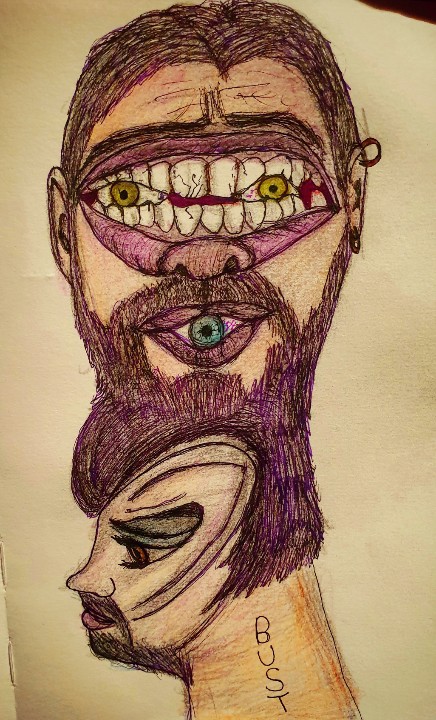
Of course none of those things insist that either face is male and not female, transgendered or intersexed. It is a characteristic of Somerled to ‘queer’ their faces (in the sense of making normative assumptions problematic). Gender signs are undermined such that we realise how much our culture demands a binary answer to gender questions, or if neither of the binary answers, a medically defined ‘abnormality’ solution. And both transgender and intersex identities fall prey in our society to the biomedical model, through diagnostics (gender dysphoria) or ambiguity in the biological organs seen as a medical problem.
But we are not finished with ambiguities here. The use of the term BUST written or tattooed onto the bottom face asks us to make a judgement whether this is an artefact, one associated with fine art sculptural traditions and not a face at all. Is it a manufactured thing? If so, why have two faces since busts conventionally are one faced entities? How do the questions of gender translate between art and facial mimesis? I have no answers.
I wonder anyway whether we are shocked from gender considerations by the contrasts in these faces between human and fantastic, even monstrous, identities. The top faces is not only disordered in its features, it has repeated features and features which morph into each other, such as lips, mouth (and teeth), nose and eyes. The eye held between the teeth inevitably suggests an eye in the process of being violently eaten, that in the lower mouth of the top face of an eye absorbed. These mouths surely recall versions of the folkloric motif of the vagina dentata which some psycho dynamic psychologists find still in the content of dreams.

Prosopognosia however, as said already, inhibits the ability to see differences between faces only. Neuropsychology always sounds like impressive evidence but art has often tested issues related to face recognition (René Magritte and Max Ernst for instance) in order to queer the perception of both reality and the assessment of the concept of the human or humanistic. The examples need not confine themselves to twentieth century surrealism since the face has been problematic in Western art since the Greeks and almost certainly before that in Non-Western art. If we look to our last example, this idea is present in the fact that the image insists that we are looking at one image with combined but disorganised features at different levels, whilst we demand that there are two. Yet why then are these faces so differentiated if one. What are the links between faces and how do we recognise them?
This is a complicated idea where the one face of one person is seen as the source of many ways in which that face can be comprehended, emotionally engaged or merely seen. Involved are endless acts of psychological introjection and projection. We could see this contest of two as one in many Somerled images but some of the most interesting link but also differentiate many faces on one linking stem (the last image above). Rather than investigate this in each pictures let’s look at a gallery of mages. But not how issues of gender, ethnicity, status and perhaps even class play across the many potential faces merge into the unitary concept of the face.

There are of course simple memes that can be used to discuss these – from classical models such as Janus, in which the duality of things or processes such as time are symbolised.

But what these images make problematic is precisely the cusp between the divided faces, where does ‘one’ begin and the ‘other’ begin.
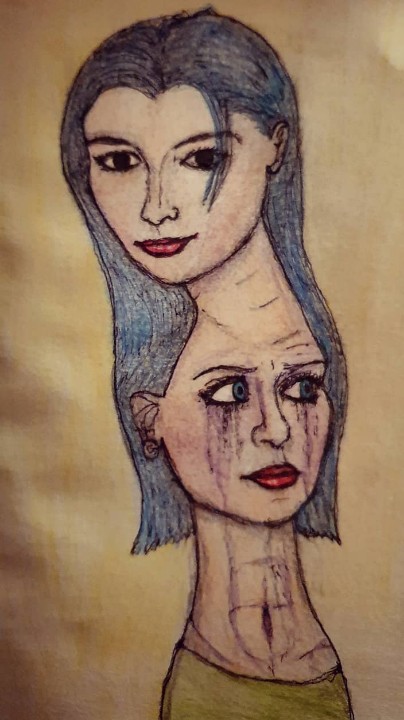
The drawing technique insists that devices in one face is also a device in another. For instance in the picture above the faint line of the neck of the top face becomes a worry line on the bottom one. These signs of affect and appearance swap meanings because of the link between these faces. They confuse not only the many expressed images and the one object that occurs as any eye sees a face. They also confuse emotional boundaries, liminal states of transition between times, places, emotions or all three in interaction. And they confuse the sense of the face as being looked at or at looking (to say nothing of looking at being looked at).
To move on though. Let’s look at how a contemporary international modern art historian sees this issue. One of the most influential books of the twenty-first century is likely to be Hans Belting’s (2017) Face and Mask: A Double History.[2] To attempt a summary of this book isn’t useful. Read it though – you’ll love it, though some of it’s hard-going. I’ll take one sentence only to lead me into a further attempt to learn for myself about Somerled’s art:
When the face is animated by expression, gaze, or language, it becomes the locus of many images. It follows that the face is not merely an image but also produces images.
p. 21 (original author’s italics).
There is more in Somerled than these two sentences contain. However, Belting does contain some clues to the problem of seeing faces as both many and one simultaneously that we have seen above. One single face can still convey the multiplicity of forces that make it endlessly diverse. It is to show the face in the act of making images. Sometimes this manufacture feels to be a collaboration between the artist’s model, their image and the artist themselves. Consider one of my favourites below.
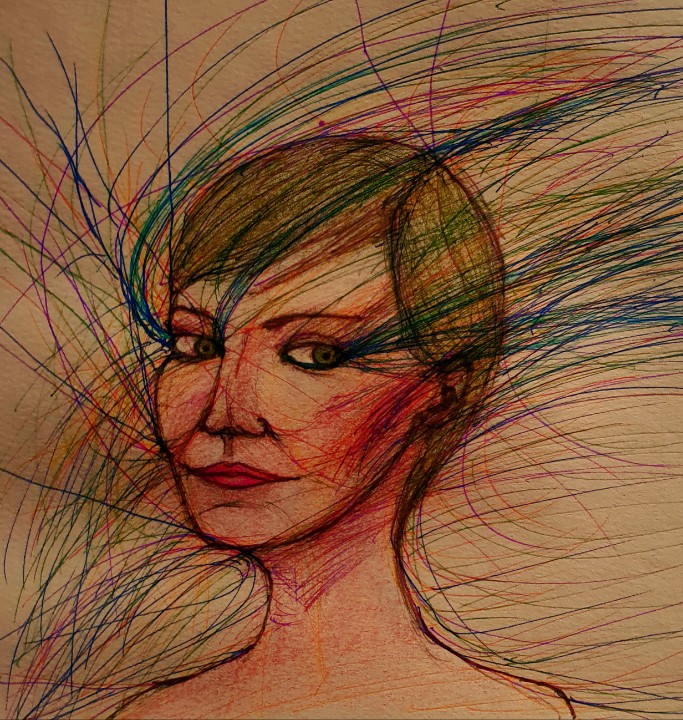
In my view of it, this image is about the devices of artistic making – indeed many of the images are. This one use devices like the line, patches and hatching to describe the ordinary material origin in art of effects of human function – like turning, expressing, looking, gazing, registering the other and being registered by the other. Coloured lines recall to me the winding web of enchantment around Holman Hunt’s capture of Tenysonn’s The Lady of Shalott Their use defines the manifold making by faces of produced images.
No time hath she to sport and play:
A charmed web she weaves alway.
A curse is on her, if she stay
Part II https://www.poetryfoundation.org/poems/45359/the-lady-of-shalott-1832
The eyes are crucial. Eyes do not passively receive images nor are they themselves passively received. They ask that they be reflected in the viewer’s sense of having appeared somewhere in front or to the side of them. The web is not unlike hair however because it is not a feature with clear boundaries. This face morphs into many forms. Is gender complicated. I think so, as all categories of identity are, I think, in any face.
The other way in which I think Somerled complicates faces is by the conscious employment marking as an artistic device. I’ll try to look at hat in the example below. These marks can be small patches or lines – continuous or not. They are not simple because they might be attempts to represent fresh cuts or the scars of old cuts on an actual face, They might be accidental or intended for harm, pleasure or visual effect, but they might also be decorative make-up of a temporary kind. They are not either art or nature then but both and make us aware that decoration, meaning and intended or unintended pattern are hard to distinguish. How, for instance, do we classify tattoos?

A relatively simple example links a face with a hand that might have made the marks. The patterns are of uncertain intention. They include inverted crosses we see in other pictures. They have a tendency to suggest blood that might be shed or an internal haemorrhage. The most painful is the cut across the left eye of the figure (our right side) which creates pooling of internal blood or bruising – a bloodshot eye. Gesture in the hand and face are hard to match, as are concepts of active aggression and passive victimhood. Perhaps that is because such binaries are mythical.
Finally we could look at a picture that on the face of it is merely a realistic photo-like capture of a face decorated with Gothic symbolism. See it below.

Clothing and hair colour seem intentionally red, as is the ank necklace. But other decorations are either drawn or cut and include symbols like the inverted cross. But others seem imposed, such as the shapes in the eye. I have to say I do not know how to think about this face, except that it confuses artistic devices used on real bodies and on other media, such as paper. It makes emotion available while causing it to be appear to be ambivalent or even potentially absent – a merely visual effect. It is beautiful but otherwise both sad and happily fulfilled, aggressive and vulnerable, violent or eminently and symbolically peaceful
After all that, I still feel I haven’t conveyed even the Somerled I see. But you can’t write for ever:
And further, by these, my son, be admonished: of making many books there is no end; and much study is a weariness of the flesh.
Ecclesiastes
And this is true of blogs too. So weary in flesh and mind (not so far then than the effect of this final picture on me) I’ll sign off. This is an artist I find full of exhausting inexhaustibility. And I love that!
Steve
[1] The link here is to: Simion, F. & Di Giorgio, E. (2015) ‘Face perception and processing in early infancy: inborn predispositions and developmental changes’ in Frontiers in Psychology vol. 6, p.969ff. doi: 10.3389/fpsyg.2015.00969
[2] Belting H. [trans Hansen, T.S. & Hansen, A.J.] (2017) Face and Mask: A Double History New Jersey, USA & Woodcock, UK, Princeton University Press.
 Steve_Bamlett_blog
One thought on “Faces, Marks and Masks: Rambling round a theme that I find in Somerled’s art as shared on Twitter (@Sumarlidh)”