Reflecting on Surge by Jay Bernard (2019) London, Vintage Penguin. Links are seminal.

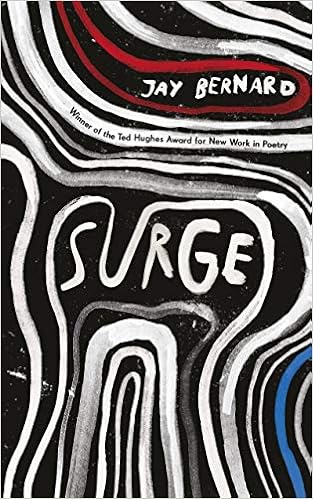
I first tried to read Jay Bernard when a first version of Surge was published in 2016 in Beacon of Hope. I failed the test, feeling that this poetry depended too much on performance art for me to understand and love it, having been brought up on poetry that proposed a silent relationship between me and something in it. This was a great mistake.
It isn’t that performance isn’t important in the poetry (its central to its queer heart). At its simplest performance is something that touches on context of presentation, including colour, sound, motion and their interactions. You can get a taste of that from the video of Something Said prefacing Jay’s website. Even when Jay[1] merely reads, they sing and that is clear in a reading, taken from a much less articulately staged performance of Songbook which appears in the text on pp.7-9. Yet look at the poem as text alone, as I did last night, everything about its orthography demands voice and articulation. As we read, we perform it orally. This may be so because otherwise we will fail to get its sense and meaning, but this is about more than reading and inhabiting, but for a while, a Caribbean dialect form, it is about struggling to position oneself among half identifications or less, even those of personal politics.
Me seh ah left side forward an me right side back
Bust up left side right side haffi change tack
Me she half de revalushun deh pun de attack
Only half a salushun to de tings we lack
(p.7)
In the poem neither ideas of progression nor revolution suffice (advancing in a serial or turning circular form) solve the issue of social identity and tis perhaps explains Jay’s statement in an interview in Segovia that issues of race and gender – however important and they are – are much less important that large issues involved in demands for more wholesale social change. In the same interview he also promoted a motto he ascribes to June Jordan: “I am not sure any longer that there is a difference between writing and living.” The whole interview is worth listening to before we go on.
In that interview they pose the Jordan statement as an aporia, which they define also as a never-ending problem. Its applicability is, they go on to say, based on the fact that, if it means anything, its meaning is only imminent; its solution as a problem only emergent. It is neither definitive in the present nor totally serious. Indeed like queerness generally it’s:
…somewhat perverse and also playful – to have something that is unfinished and also ambivalent as a personal motto.
So it’s difficult to pin Surge down to a single theme or event narration. It is always about more than you think it is as writing, even when addressed as many poems are to the New Cross Fires or to Grenfell. But that is because these were not events but huge moments in the exposure of the fact of social injustice that includes poverty, marginalisation and repression of resistant voices, whatever these voices are saying to the status quo.
Even single words are more than they might appear and my favourite here is the word Pride, as the title of the poem on p. 43. This encapsulates not only Gay Pride marches but the marches that resisted the press response to New Cross which also appear in this volume – a fundamental pride that says that they will not be diminished by how they are written and spoken about and ‘housed’ or otherwise accommodated by a society that puts them at the margins:
My body taps me on the heart when someone in soft leather swims
into my ken, that smell of squat and underground and every other lover,
scent that throws off shame these days I pass you in the street,
though I want to turn around and thank you for the tongue in my throat,
…
(p.43)
That last line ends in joyful articulation for things a world without imagination might call bad smells, negative associations and ‘shame’ – but here articulate pride.
The world of Jay Bernard celebrates what won’t and can’t get celebrated like the life of a transgender person, Naomi, superficially remembered, (pp.34f.), two boys who hide from each other lest they prey to ‘death painted fifty feet high’, until to each other they ‘undress’ (p.42), Miss D the itinerant lover and loser (pp. 31-3) and the young gay Jamaican killed in the press of a ‘crowd thick as a carnival’ : squat him batty’ (p.23).
As in the last instance there are many instances where joyful solidarity still suppresses much pain in those who fail the test of normativity. There is, in the noisiest, public performance poem a quiet heart – that contains corruption in Duppy but is also about beautiful acceptance potentially – a crowd where we all fit.
For me the great poem of this latter kind is Pace (p.36). This poem is about itself – about a poem as a relationship between people, sometimes multiple people that intersect (and that’s an important word). It even contains an ‘aporia’: ‘a question that’d always been asked’. But it is, when read quietly or in public (in either case identities multiply in the poem lie they do in Whitman in different intersecting ‘you(s)’).
I have seen the light you’ve seen
and my body has been where yours has been
some part of me resides where you reside
we’ve swapped presences and parting –
p. 36
Intersections are presences and partings. You is singular or plural. To be unaccommodated (that ‘squat’ again) is to be accommodated with everyone in everything. This poetry will grow with anyone who reads it.
Steve
[1] Jay is a queer poet who avoids binary identification, preferring the pronoun, ‘they’.
 Steve_Bamlett_blog
One thought on “Reflecting on ‘Surge’ by Jay Bernard (2019) London, Vintage Penguin. Links are seminal.”