Reflecting on the images tweeted by Somerled of their own art. With thanks to Somerled.
‘Bishop Nicholas of Myra, Asia Minor (270-343AD). Known as the “Wonderworker”, Nicolas, a secret gift-giver, is patron saint of sailors, repentant thieves, merchants, archers, brewers, pawnbrokers, students, prostitutes, and children,’
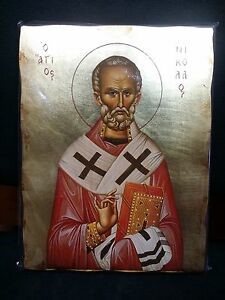
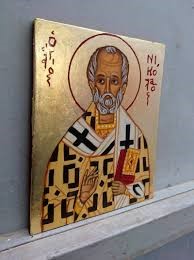
is how Somerled describes the subject of their drawing which looks (see below), as reproduced on Twitter, as if it might be in pastel and/or watercolour. And it clearly refers to the Byzantine icons above of Saint Nicholas (each of the examples is inscribed in Greek with that name). Both icons have the same frontal pose and gesture, although only the second directs his gaze directly at the viewer. The top one has its pupils diverted to his right, our left, as if in saving us from the more fearsome moral gaze of the second icon.
In both cases though there is a kind of impersonality. A professional art historian would date and geographically locate them with precision based on a number of such features. I merely wanted to pose them neat to Somerled’s St. Nicholas. The similarities are but superficial but do betray some kind of influence or suggestion. The image is frontal and the eyes capture and fix the viewer but not in any sense of judgement. Even the ecclesiastical vestments have about them an everyday warmth. And the face has a kind of visual depth to it. Quite unlike the Byzantine instances that face appears to emerge from the picture surface, not least the forehead as it catches light near its centre, making a kind of illusory third eye from the scar tissue of its remnants.
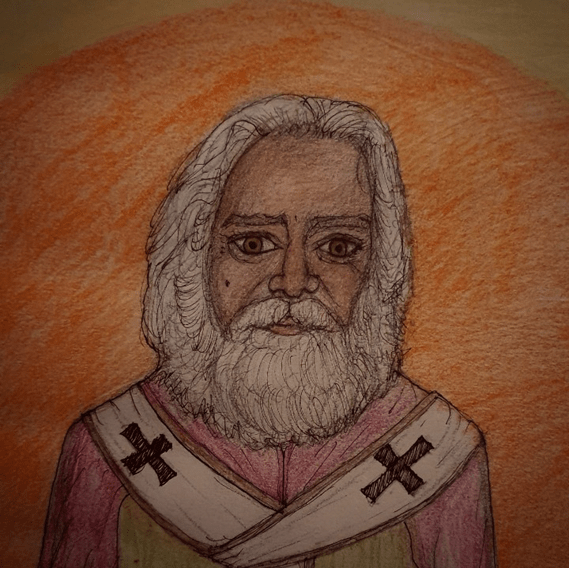
Of course I can’t convince you of what I see but the third eye is certainly a feature of Somerled’s portraits. Let’s see a more obvious one.

Eyes are important to this artist clearly and I’m supposing them to serve to capture the viewer in their gaze and implicate them in the construction of what they see. The third eye is an ancient symbol with many associative meanings, spiritual and otherwise, and sometimes seen as a means of denying the dualistic qualities of what we otherwise see as binary in the world. This wonderful picture scars out the two eyes in lines which might either be old wounds or the planning line of a facial surgeon, even showing the direction arrows for the direction (upwards through the eye) in which cuts will be made. Those lines frame the third eye, off-centre from the nose and thus directly challenging the notion of the symmetrically placement of the pineal (or parietal) eye. It is both placed in dual triangle markings bi facially but also bears a distortion, in its main outline of the Egyptian eye of Horus, with its association with BOTH the evil eye and the eye of grace.
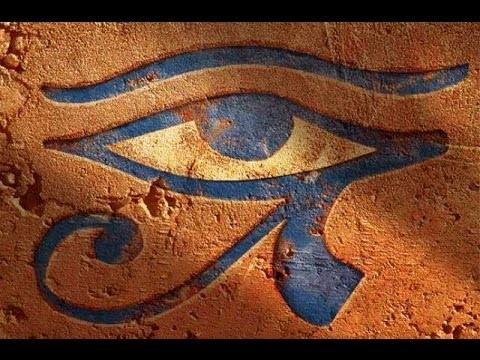
In my personal interpretation I see potential to both good and evil here, perhaps even a Nietzschean place beyond both. Being looked at tests you and your influence on the visual world and the potential of the visual world to place you both in the moral balance and beyond it. I find the Somerled images above haunting but in both cases also ultimately ‘saving’. They invite me to cut the eyes that see both of many possibilities for me but congratulate me if I do not. St Nicholas actually heals in looking – the secret gift being exchanged between us.
But now for a very different image. One I feel that bears many of the meanings suggested above but with much more intensity, especially in implicating the viewer in its pain and evil.
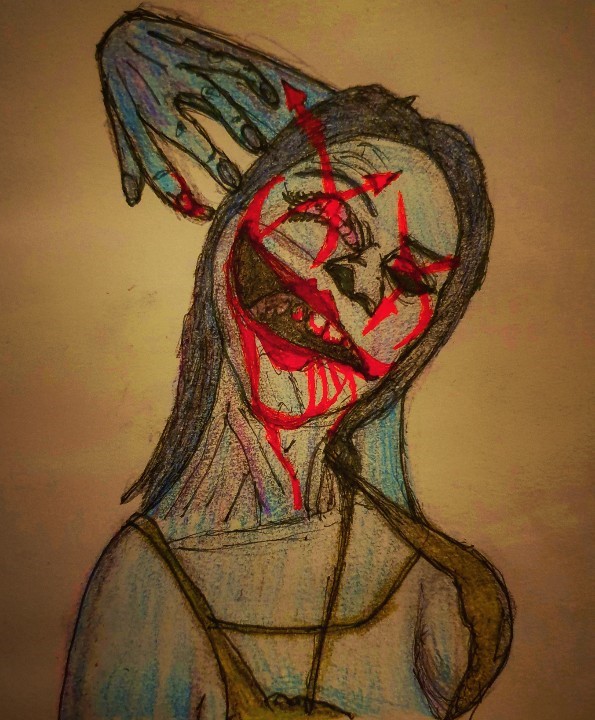
The third eye occurs in many places but notably it takes the place of the mouth, distorting it, and implying its ability to hurt. Both eyes are here fully eradicated by lines hat now have the colour and flow of live blood rather than of a healing scar. A nail of the sitter’s hand has clearly been implicated and is marked with blood too. The evil eye is suggested in the shut eye on the right as well as the mouth. The direction lines show marks that signify active violence to and bidirectionally across the whole face. The place of the third eye is only signalled by these cut lines. Recently Somerled has helped us with this image showing some of the influences in this source material.
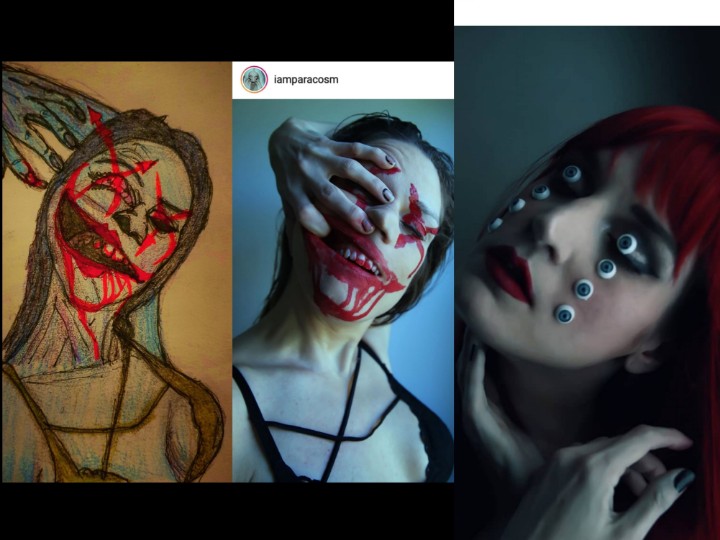
There is of course direct influence and there is interest in both in making up and the use of eyes in such making up, as if to symbolise the importance in fashion of the fetishized gaze. But although the lamparacosm images paint eyes out of substance that could be blood or lipstick, the Somerled picture takes the hand away from the face such that it does not obstruct it but also such that it also has a dynamism moving diagonally across the face from right to left and distorting the mouth into the evil eye. In my reading I think this again implicates the viewer in creating damage to that face, in being the evil eye that has harmed and scarred it and which may be struggling to free itself from the horror of what it is capable of doing. Somerled’s image is thus much more frightening and haunting. It may suggest that the viewer is a skin surgeon playing with the female face but it also implicates the eye in self-harm, as an external agent of an apparently internal action of the person gazed upon and who the one scapegoated as the harmer rather than really being such.
Well it’s just my view.
Steve
 Steve_Bamlett_blog
One thought on “Reflecting on images tweeted by Somerled of their own art. With thanks to Somerled. @Sumarlidh”