For my note on the film see: https://stevebamlett.home.blog/2019/11/07/ken-loachs-sorry-we-missed-you-a-difficult-watch-in-cinemas-now/
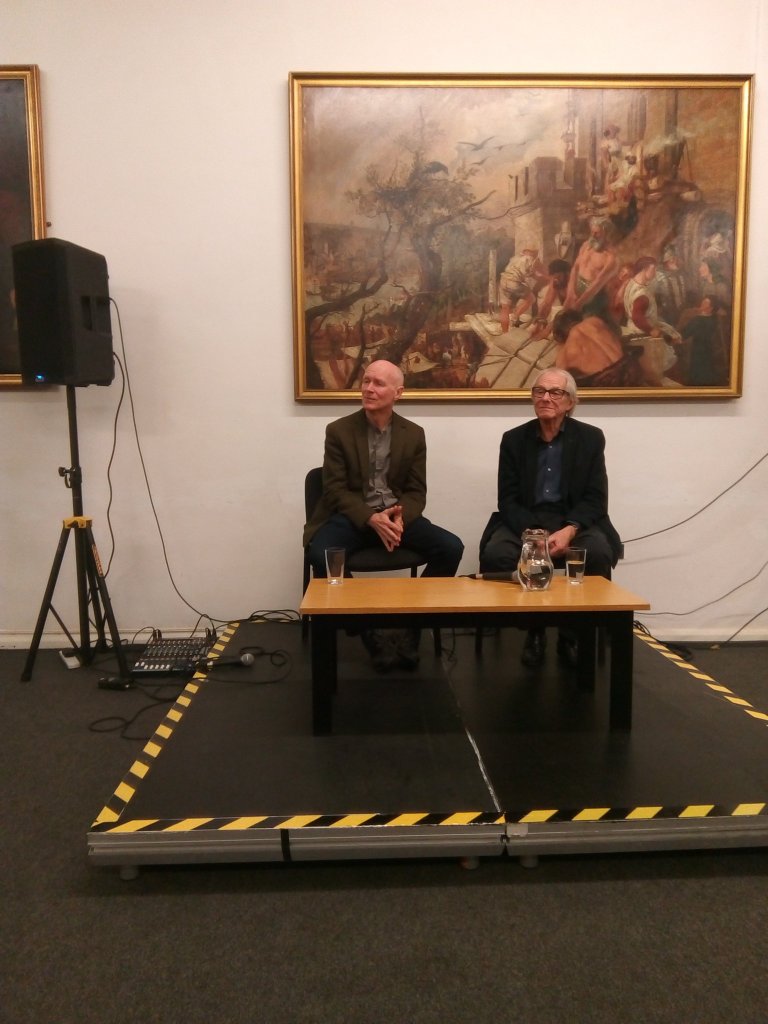
Was social justice ever easy?: Ken Loach and Paul Laverty at the Newcastle Literary and Philosophical Society 4th December 2019 12.30 – 2 p.m. My take on ‘Sorry We Missed You‘
Today was special. The Lit and Phil was the voce of radicalism and science in Newcastle and remains what Ken Loach called a centre of humane political discussion and civil society. There’s a kind of awe as you cross the road to its entrance.

To see the foremost international socialist filmmaker and film-writer, both together and ready to talk about Sorry We Missed You was even better. But this was not constructed by our hosts at the Lit and Phil or their famous guests as a passive audience with celebrity but a participatory event in which the audience was invited to contribute.
That usually means (check it out when you go the Edinburgh Book Festival next) that one is allowed only to ask questions of limited focus. Here comments and narratives from the audience member’s own perception were welcomed. One lady of great dignity in the audience presented with her husband the despair coming from the way a system geared against human need and for profit has, and continues to, damage her son’s life following a severe mental health episode by treating him through a barbaric system of ‘work’ allocation that cannot meet his need or acknowledge any short-term vulnerabilities.
But questions there were. Asked if the screening of I, Daniel Blake had changed anything about society, Loach rapidly said, ‘Bugger All’.
But he was taken to kindly task – not least by a leading person in the Newcastle West Food Bank featured in that film. She said that the Food-bank had been focused and helped and drawn to it more of the hidden need of the area. It is now feeding 4000 people in need. ‘I’m not proud of that fact,’ she said. It’s a measure of the absolute need each application represents. Stories from families now come from from many working families like those in Sorry We Missed You. Who could be proud of that? Nevertheless we recognise that food banks must continue whilst right wing solutions to social security are hegemonic in our ‘politics’?
Those ways cheapen the value of working-people and their work in the marketplace. Others talked of having their minds changed by the film but all recognised the sway of the press and TV media in distorting the Loach-Laverty message, reducing it to a perspective from the left rather than being what it is, an extension of the narratives that our culture makes available to us to people otherwise muted by the current structures of power. Stories only a tragedy like Grenfell Tower sometimes let loose.
The talk started about the problem of the social acceptance of narratives to represent the world that in fact only tells the stories of few, whether in novels, films, poetry not the many and cheapen the value of the latter whilst they raise that of the truly ‘unrepresentative’. After all Ladybird Ladybird tells a story as tragic – as heightened and difficult of solution as stories of male kings such as Lear and Oedipus. Stories where a working-class women learns to face her tragic flaw and to re-channel the anger her society has produced in her.
For Loach and Laverty films illustrate not ‘social realism’ first but the means by which consciousness of the social is formed, maintained and then tested. Testing can lead to tragedy – and mostly it does – or to politics. We need to know how to target anger in the public realm to change things for the better. For the enemy may be within. They spoke of film showing the ‘mind-forg’d manacles’ that Blake discerned as the means of maintaining poverty, inequality and other evils in his poem London. And those manacles can be traced back to the Ridley Plan under Margaret Thatcher, the basis of an ideology of neoliberal individual freedom, or an image of it, that would bind us to slavery to capitalism. An entrepreneurial myth plus privatisation ties us to capitalism whilst, if we are poor or under-resourced keeping us subjected to it rather than subjects living within it. As Loach says films are part of the ‘struggle for consciousness’.
In the end we need to take control of he narratives used to represent life not in films first and foremost but in political action and manifestoes like that presented to us by Labour for December 12th this year. What happens in that election will shape the task. Not least that if Labour win they will faces as desperate a pressure not to deliver on that Manifesto from the right and from the softly temporising Labour Left represented by Stephen Kinnock and others.
It was inevitable that the conversation would turn to Jeremy Corbyn and the mendacious lies used to blacken him. Most of us gasped when Loach revealed that he had himself only yesterday been called a Holocaust denier in The Daily Mail. The cause of course, it can be guessed, was his lifelong support for Palestine. But such accusations hurt. Loach, like myself, forced himself to watch the footage that proceeded from the concentration camps to modify any great filmmaker’s appreciation for Leni Riefenstahl, and because, he has always stood up for the rights of Jewish people.
We need to see these heroes and their wondrous films but we also need to remember that their effect is limited if not ‘Bugger All!’ The effect can only be realised when minds are changed – not least but definitely not only our own. To get the many to realise that their interests never will be those of a few, that an organisation of society based on human need not greed and profit can realise those needs and that such a society need be democratic.
The inevitable question came. Where is there an example of such societies today. Laverty’s answer was one that shook me. The examples that one would use, such as Chile and Nicaragua, were both left-leaning social democracies that were stamped out by with violence. There is no doubt that such threats would be posed to a government of the social democratic left after December 12th. No path is easy. Was justice ever easy?
 Steve_Bamlett_blog
One thought on “Was social justice ever easy?: Ken Loach and Paul Laverty at the Newcastle Literary and Philosophical Society 4th December 2019 12.30 – 2 p.m.”