Celia Paul (2019) Self-Portrait London, Jonathan Cape.
There is a fascinating story in David Constantine’s latest short-story collection that revolves around, as does other of his fiction, about what it actually means ‘to read’ a book that does not exactly follow the conventions that allow us to recognise that we are, what we normatively call, ‘reading’.
The reader views the page; and the composite shape, the juxtapositions, the relations between parts and the whole, are static. The medium insists on fixity. But the spirit of the whole endeavour is quite the opposite: it is the principle of eternal instability, of ‘everything moves and flows’. The fixity of texts and photos on the page allows us to see a particular shape, but the imagination and the heart and the pulses feel its undoing, its return to the matrix, its rising again into another and different fleeting incarnation.[1]
[1] Constantine, D.(2019:78f.) from ‘bREcCiA’ in Constantine, D. The Dressing-Up Box UK, Comma Press 75-98.
I’m aiming to review these stories when I finish the book but it reflected back on my previous read – one I hadn’t exactly intended to reflect upon. That book is Self-Portrait by Celia Paul, the painter-artist.
Paul is less well-known than she should be, and when know, known as one of the many women with whom Lucian Freud had relationships and one of those who bore a child of his. This book, by the way, takes those characteristics of herself in art-historical memory as her basis. The first named chapter is ‘Lucian’ and this chapter name recurs through the book.
That first chapter gives all of the facts Paul considered significant about the genesis of her relationship to Freud: the pattern of seduction followed and the admixture in her own mind of his importance as an artist that might judge her own work:
… He lifted up my hair and buried his face in it. He asked me if I had read the poem by Baudelaire, “…. Swimming in your perfume, the scent of hair … rather good, don’t you think?’ he murmured.
He pulled me gently but insistently into a standing position. I watched him kissing me and my mouth was unresponsive. I saw the whites of his eyes and he looked blind. His head felt very small and light as eggshell. I was frightened. I asked him what he thought of my work. He said that it was ‘like walking into a honeypot’.[2]
Paul (2019:20)
The tropes of romantic sexual love and entrapment sound hollow as processed in the fearful but also controlling precision of Paul’s prose. It states her fright but also advances controlled perceptions that ridicule the romantic hero in Freud and reduce him to something little more than an object. The subjective effects of being powerfully seduced are reduced to something we are made to see to be ‘very small and light’, something more fragile than its pretence (blankly white and blind, eggshell) rather than a self of powerful, persuasive agency. This is brilliant.
At this point in the narrative Paul leaves the house before she can be successfully seduced. Why does that resonate in the book?
Before the scene quoted above she had seen Rodin’s statue of Balzac, a version of the ‘pot-bellied naked man’ with a ‘massive head’ owned by Freud and situated by him in his lobby. Later she is told by Freud how Rodin himself enforced upon a mistress who was also an artist (this story of Gwen John will resonate) that she renounce her own art to serve Rodin as model and domestic goddess. For Paul the need is to be something other than the manipulated model, whether as a sentimentalised and perfumed sexual honeypot or as the one created by the artist for the artist.
Yet this theme arises in main because Paul uses breaks from the convention of book in order for us to see it. As Constantine suggests in his story, a book that breaks chronology, allows repetition and constantly plays with our expectations of how text and images correlate, queers things. This means that Paul’s book too, apparently static, is full of characters that metamorphosise through fleeting ‘incarnations’ (in pictures or speech rhythms) that live in the fluidity of our reading of them. And that is true, whether are reading a picture or a passage of prose or the gutter of space that lies between them.
The last section of the novel is called ‘Painter and Model’ and refers to a late painting of that name by Paul – a ‘self-portrait’ (in which she is both painter and model).
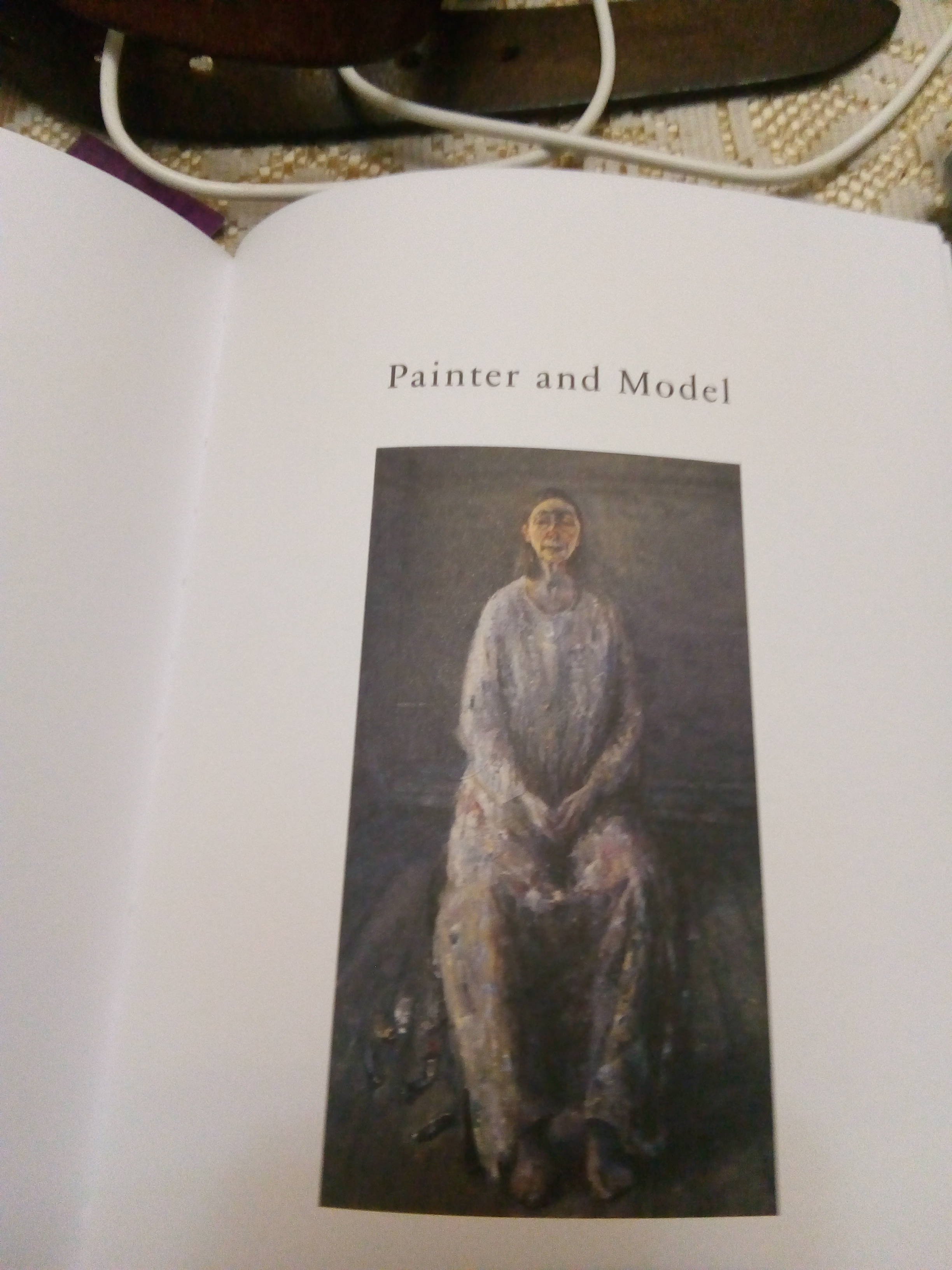
To emphasis this she points out how its iconography refers back to a painting by Freud of her with the same name, although in that her model is her naked gay male friend, Angus Cook. Both paintings emphasise that she is an artist because the floor is littered with squeezed paint tubes.
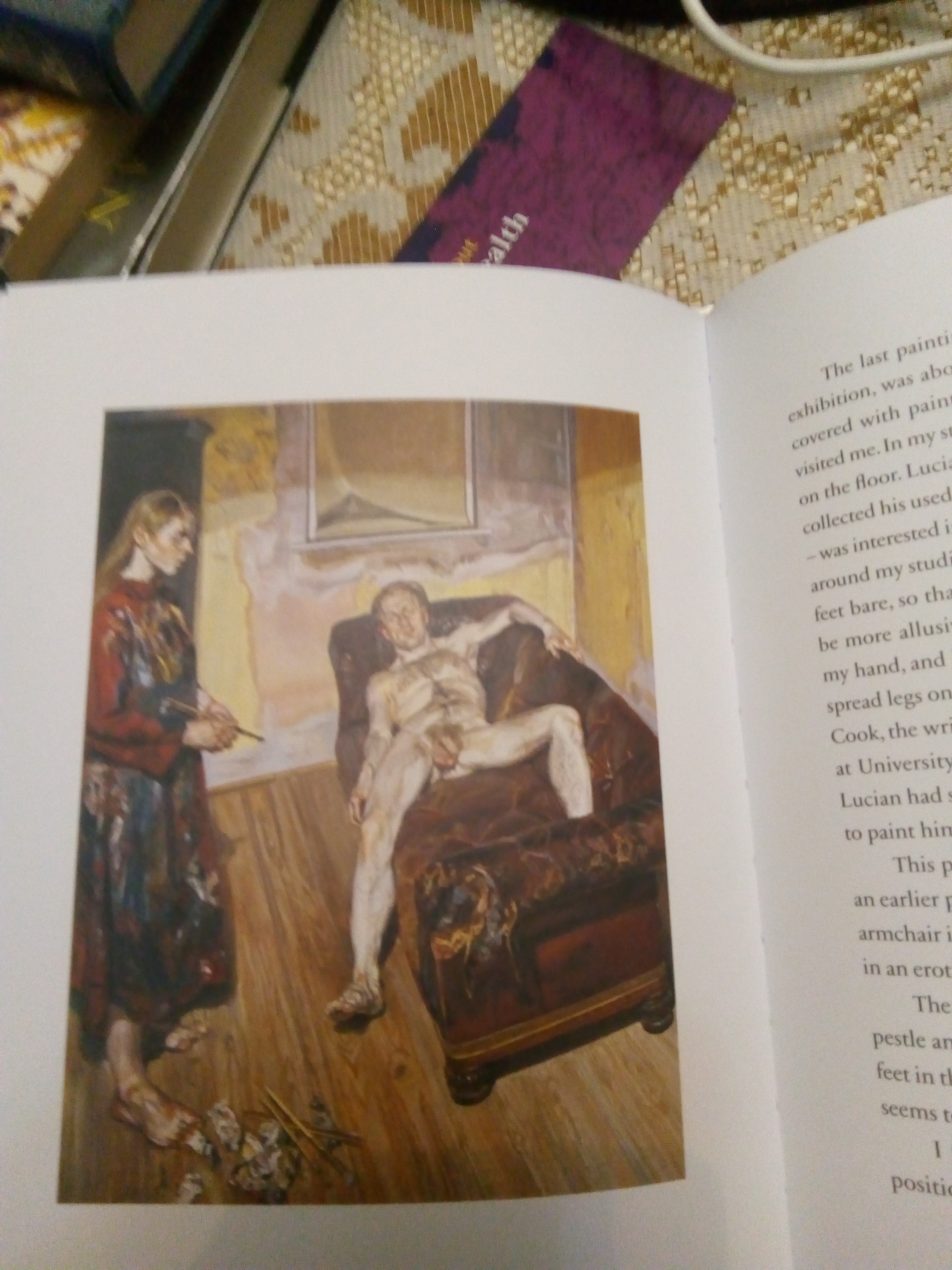
However, whilst in the first she does so ‘following his instructions’, in the second the tubes have been discarded by her, used by her, with no instruction from a male artist of huge pretension. When she talks about Freud’s painting she points out how the instructions she followed by Freud allowed her to take on the ‘the powerful position of the artist’, but only in order to dramatise the fact that ‘his recognition was deeply significant to me’.
Of course we do not see Paul’s own picture of Angus in Freud’s painting only that which was consummately performed by Freud. Celia’s painting of Angus is absent. She points out that in Freud’s painting her naked ‘phallic toe on the squirting tube of paint’ and the fact that the directive angle of her paintbrush in relation to Angus points to his focally placed genitalia. These features of that painting ensure that both power and desire focus on male iconography of both ‘power and desire’ rather than female ones.
It is only in her own ‘Painter and Model’ that she is consummately and self-organised (or even self-disorganised) as an original artist painting and creating from her own power and in the interests of expressing desire as she sees it. As she herself points out as model and painter she expresses in this painting her ‘affinity with Gwen John’:
I am, like her – she famously posed for Rodin and was passionately involved with him – both painter and model.
Paul (2019:192)
If Celia Paul uses this book, named ‘self-portrait’ to dramatise and role-play anything, it is the advent of a vision liberated from that of Lucian Freud, while not erasing the debt she owed him – not least the debt that was HER son Frank.
In this kind of innovative book genre, Paul’s ‘autobiography’ is a matter of graphics, juxtapositions of graphic figures and texts that demand you read and incarnate her in the queer metamorphoses that make up her life as artist and person. The final paintings (pp 201 – 5) show five beautiful images that illustrate that her room with her view, originally bought by Freud, is now her room – a room of one’s own – and registers a vision totally unlike that of Freud. Here is an example opening:
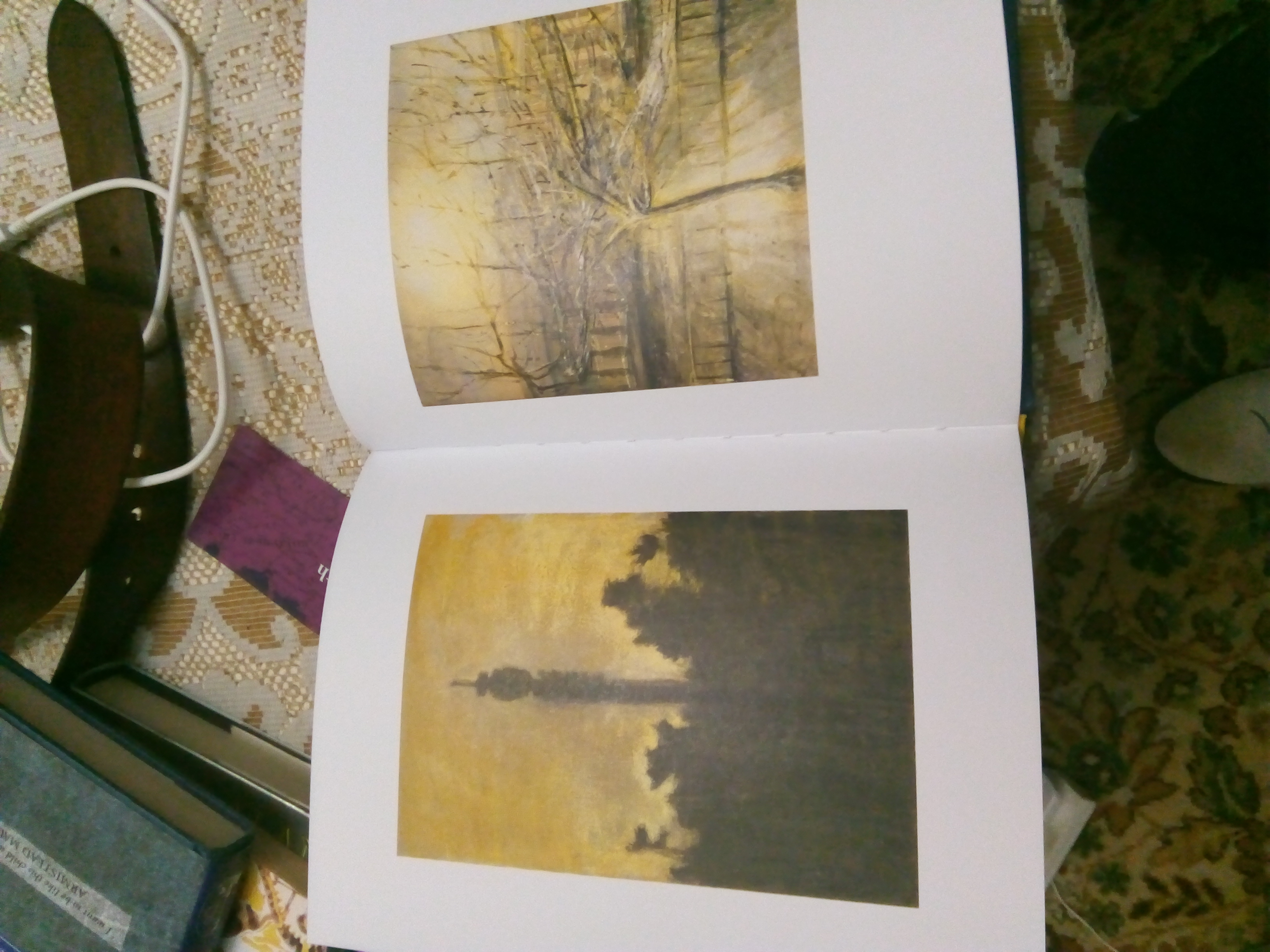
It is a room, in her last sentence, where, ‘I pick up a brush’. No-one instructs or guides that hand.
It is a book that I think demands the kind of reader described by the ever-brilliant David Constantine. For me that comes across in one of my favourite openings in it – holding both images and text relating to her friends (both artists) Angus Cook and his male lover Cerith Wyn Evans. Freud famously painted these lovers. But Freud demanded nudity in his painting, in at least one partner. Although, of course, his painting is extremely important one for gay male art-lovers (myself included), it lacks the perception of Paul’s picture.
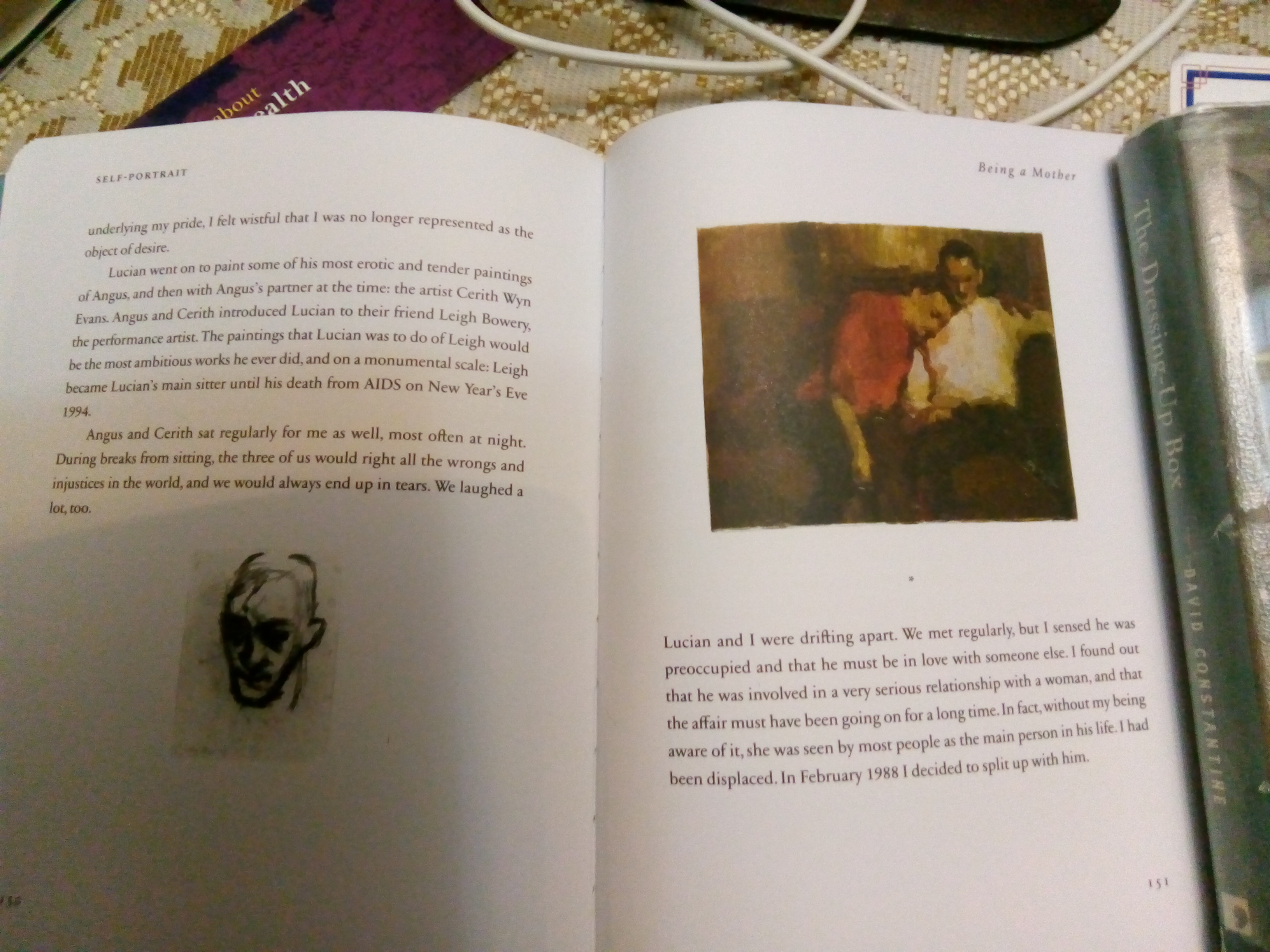
Both lovers are clothed. This painting speaks of the comfort of male bodies, in such circumstances, with each other – in a blending where the sexual is not necessarily prioritised because it is bonded into the gesture and the juxtapositions of colours, faces, heads and attitude. This is a picture of incarnated love. It happens when Paul herself ‘decided to split up’ with Freud and take on the first of her female lovers.
This incarnation of queer love, and of what I like to call ‘homo-somatism’, is one of the many effects of the fluidly queer readings that Celia Paul’s great new book and Constantine’s queer (in the sense of being cerebrally non-normative) insights into what reading a book might be.
 Steve_Bamlett_blog
10 thoughts on “Reflecting upon Celia Paul (2019) ‘Self-Portrait’ London, Jonathan Cape.”