The Norman Cornish Sketch & Drawing Exhibition at Palace Green Library visited 22nd November 2019.
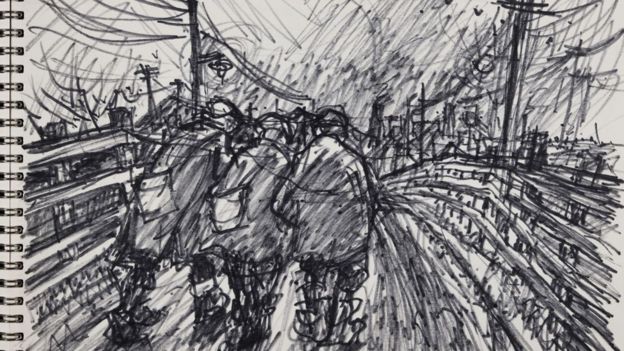
A spontaneous sketch from a Norman Cornish sketchbook. Available from: https://www.bbc.co.uk/news/uk-england-50365848
A reflection following first visit. See also Bowes retrospective piece (link opens new window):
There are 3 Cornish centenary exhibitions I’ve visited thus far this year (the others at the Mining Art Gallery and the Bowes Museum – see link above for latter) and this, though small, is so exquisitely curated that it is perhaps the best – not least because of the clever use of audio and digitally accessed archive material.
You must see the medley of centenary films, including bits from the BBC’s Norman Cornish in Paris, which I’ve never seen. Key to this set of short film is one on his and his wife, Sarah’s, birthplace and place of residence, Spennymoor, in which Cornish says that he loved it because it contained nothing that was special in itself like a ‘cathedral’, if chimney pots and streetlamps of the period were not special. Instead, ‘people themselves were the cathedrals of that place’. And it is that almost religious take on the nature of people that emerges from the exhibition. Drawings of Sarah darning make this personal.
Here are drawings, often sketches preliminary to other paintings (ones in the Bowes for instance), or other versions of central memes in Cornish’s art – the pit road, the gantry, known streets and public houses. One version of a pit-road is that which shows most clearly the analogy Cornish made between these paintings of ‘man-made scenes’ against the backdrop of a larger non-human universe and Van Gogh’s Starry Night paintings. In these pit-lanes, whether people are represented by a solitary or as on the way to work in a greater group, Cornish’s interest in isolated men and their interior lives speak out from some of the fine quotations used on walls, for instance this from a more populated and yet intrinsically lonely pit road painting:
To watch the man ahead of you plodding resigned through this man-made world is a subject which demands to be drawn again and again.
However, the exhibition starts with Cornish at the pit at 14 and a tiny few of the great underground sketches, always done afterwards in reflection like Tom McGuinness did, that he later shied away from, much as he did from the pit itself when he left it in 1960. One of the audio archives reveals the name men gave to the Dean and Chapter pit – connected by a now-disappeared pit-road, to Spennymoor: it was The Butcher’s Shop in honour of the maimed individuals who survived it and those who did not. It is not only the gantry scenes that show men reduced by machinery and dirt but the bowed arches in which men stooped in long underground pit roads. Here curved lines buckle under the weight of destroying earth above you, as in the wonderful drawing in charcoal (appropriately) on paper, The Curve (undated).
Cornish’s townscapes excel because of his love of the shapes made by old lamps and leaning telegraph poles and wires, and the changing roof levels of mining terraces as they appear to slide down hills. And then the there are the precarious chimney stacks!: together with, in the drawings, circumnambient effects of light playing through the dirt that has collected in the air.
Here again the films come into their own because they show Cornish drawing. And though his line drawings are good, one can see that in his drawings figures and shapes emerge through fuzzily-edged patches of pencil, crayon or charcoal hatching, or wide broad strokes of the flatter areas of the instrument used. The idea that his figures emerge from movements of his material on paper is clear if you see the films here. Hatching can make the lined face of an older or broken man or indicate a tension in the face of a smoothness created by pencil or crayon strokes or even the blank white within a line-drawing.
The sense that Cornish discovered his male figures rather than reproduced them is clearer in the sketches than elsewhere and I came away from this exhibition with a greater sense of his artistic mastery than I have ever gleaned before. He feels like a giant amongst men and artists.
However, I don’t back down from my feeling that Cornish is greatest when he paints male communion – a pub street or in the merging of two heads in talk about … well it might be the whippets they hold, but it might not. Again the meme used by Cornish appears here of interacting heads as constituting a ‘bridge’ of communication. Between his men are sometimes not spaces but vigorous and obvious hatching effects and loss of line boundaries. Communication is ‘craic’ (pronounced crack) through which men lose their isolation and male communities share communion. And after seeing the sketches, you enjoy the drawings, such as ‘Enjoying the Craic’ all the more. For Cornish bridges were a form of drawable intercommunion of men, such as I find, in the piece mentioned in my earlier blog, The Busy Bar, with the circling shapes of its intermingled heads.
This will not be the last time I visit this rich exhibition. Filling in my live feedback I called it the ‘best curated’ of the current centenary exhibitions. My impression was a strong one and maybe indelibly hatched into my brain. But I know what he meant by insisting that his people were the embodiment of great cathedrals – of a great religion of humanity (I think).
 Steve_Bamlett_blog
One thought on “The Norman Cornish Sketch & Drawing Exhibition at Palace Green Library visited 22nd November 2019.”