Notes on ‘Talks at the Tower’, Bishop Auckland. An Introduction to Poussin’s The Triumph of Pan, Dr. Francesca Whitlum-Cooper from The National Gallery 21st November 2019.
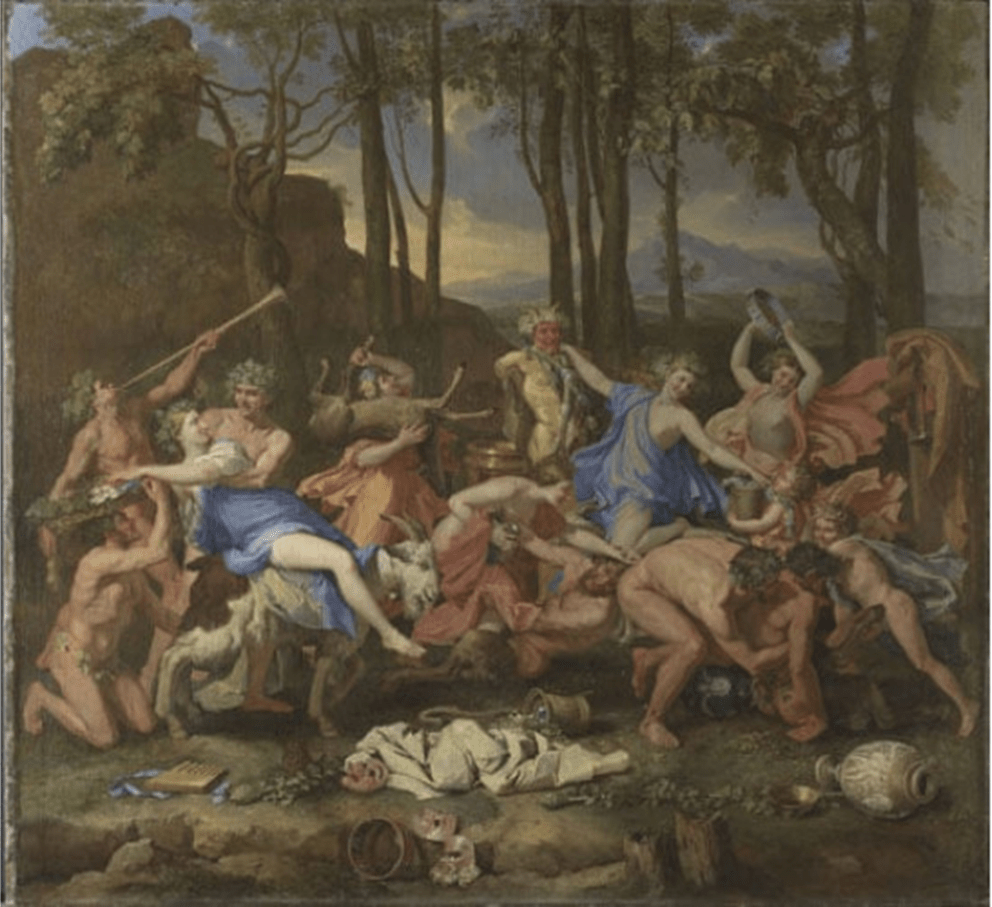
A reflection, consulting:
- Bull, M. (1995) ‘Poussin’s Bacchanals for Cardinal Richelieu’, The Burlington Magazine (137: 1102 (Jan. 1995)) , 5-11 . Available at: Stable URL: https://www.jstor.org/stable/886396 (Accessed: 21-11-2019 15:50 UTC)
- Verdi, R. (1995) Nicolas Poussin 1594 – 1665 London, Royal Academy of Arts
The Triumph of Pan (1635-6) is on progress through its 3 venues, sent off by the National Gallery and ending its tour at the Trevor Gallery, Bishop Auckland Castle until January 5th. But with it a rich collection of contemporaries are on show in Bishop Auckland and a number of studies for the painting by Poussin from the Queen’s collection at Windsor, rarely shown together with the painting, even in the National Gallery.
This introductiory talk dealt systematically with the following topics:
How to approach and engage the painting. It was suggested we see it as a ‘party’, one very much in progress in which the organised assembly is seen falling into disorder, into wildness. This is a useful start though it was noted that we had to also notice the counter-evidence – the sacrificial deer, the element of ritual. However, the signifiers of wildness and stilled noise predominate. This general approach was tied to the iconography of wildness in the ‘herm’ statue, associated with Bacchus, Pan and Priapus. This, if it is wildness, is ‘wildness’ tamed by art as in the best classical pastoral with the stock figures of this here and I pursue my reflections on that later. The Pan Pipes, the shepherd’s crook and so on in the foreground. The red face of Pan was noticed, as if of a mask. Before attending I discovered a 1995 essay by Malcolm Bull that has an interesting explanation of this based on a theory about a possible source suggestive of the painting’s commissioning patron, Cardinal Richelieu, who was born in Chinon (known in France as the ‘country of Rabelais’). Bull (1995:10) notices that classical Roman authors:
describe Priapus as ruber. But none of these authors explicitly mentions the redness of Pan’s face, whereas Rabelais, in a passage that is otherwise based on Lucian, adds the detail that in the mosaic the face of Pan is depicted as ‘rouge et enflambé’.
Since such theories stay literally unprovable, they weren’t dealt with in this introduction. Instead a clear presentation was given of the possible confusion and overlap of the figures and their iconographical meanings in all of Poussin’s Bacchanals, of which The Triumph of Pan is but one, of the qualities of Pan, Priapus and Bacchus. All three appear separately, and perhaps combined in the Bacchanals designed for one room of Richelieu’s chateau. The title of our painting was not by Poussin and may mislead if we treat the figure of the herm statue in the painting as necessarily Pan. After all, the give-away erect penis of Priapus, if he is intended, is deliberately obscured in the painting, even if exists. This is Poussin almost certainly confounding identity in a tease as for scholars to blink over (Bull 1995).
The Painter. This was illustrated by the 1650 self-portrait but concentrated on the fact that , though born in Normandy in 1594, Poussin had gone to Paris in his teens but was forever on his way to live amongst the treasures of Renaissance and restored antique art in Rome. Once in Rome he lived there for 40 years, almost continuously. And seventeenth-century Rome was that of the Counter-Reformation wherein the glory of Baroque begins to develop itself into great inventive fancy, but dependent on models from the antique, which a new thriving archaeology was further unearthing, with the extant glories of the Renaissance (Raphael, Michelangelo and the rest…). A new aesthetic based on ideas of ‘classical’ proportion was being now codified as limbs of statues were measured and compared numerically.
The immediate sources. These were traced from the drawings and prints based on antiquity through to Bellini and Titian. Ancient nude statuary in action, such as the Borghese Gladiator (c.106 BCE) provided a model for the putti type youth on the extreme right of the processional in The Triumph of Pan. Such models were even copied for the fallen wine urn that appears in the painting foreground with its copied scenes of wild revelry. The sources are:
Ancient friezes from Roman sarcophagi (example from 2nd century BCE was shown) and copies thereof. The characteristic is of a lateral strip processional in light relief moving from left to right. This is the frieze-like strip model for later drawings and, of course, The Triumph of Pan.
Giulio Romano A Sacrifice to Priapus (1532).
Bellini’s The Feast of the Gods (1514/29), which is rather post-party in mood the speaker thought. Titian The Andrians (1523-6) in which the effect of Bacchus’ conversion of the rivers to wine is observed.
The studies. Briefly we are shown these to note, especially, that Poussin often reconfigured the spatial placement of his figures in search of the best effect. He used, it was said, a theatre type frame in which he could move wax figures of his to-be drawn figures to judge this. We were shown reproductions of such figures. The studies in the Bishop Auckland collection are placed in the same room as The Triumph of Pan to ensure the best comparison opportunity possible.
The Patron. Duc de (then Cardinal de) Richelieu 1585-1642. A tri-partite power in the state, representing:
Government as ‘First Minister’
The King as his chief adviser
The Catholic Church as Cardinal.
Richelieu cemented his power as a great collector of the fine art of the past and as commissioner of contemporary artists such as Poussin. In 1635 he took residence in a chateau near Poitou in which he planned a Cabinet du Roi to showcase the art that reflected his power and discrimination. Together with Renaissance and Classical examples he commissioned the 4 Bacchanals by Poussin, such as:
The Triumph of Bacchus in which debauched wildness could also be read as containing pure meanings known only to the learned and powerful – this justification allowed the rich and powerful to have their cakes (and beefcakes) nude whilst claiming that they represented pure unsullied Christian truths as meanings hidden behind the iconography.
Finally, The legacy. The speaker opined that great art was that which could be reviewed through its interpretative use by later artists, including the groups who had responded to the painting in exhibits at the back of the hall that evening. There was a rich group of artists who used Poussin as a model to learn their art by revising his images, such as David’s The Death of Marat, Cezanne bathing paintings and Picasso’s 1944 Triumph of Pan.
Thus, above, my notes of the evening, which will, of course in no way measure up to the original. Nor can they claim to be authoritative or a good copy of the original. However, good talks, like good paintings, inspire reflection and speculation. Here are mine.
The painting seems to represent both a way of reproducing and representing motifs of wildness, bestiality and disorder but is also seen as a model of great art, which is ordered and refined. My own feeling is we are indeed given wildness, but it is wildness ordered into hierarchy. If there is noise represented, art also stills it into reflective silence (a bit like Keats see happening to the wild activities on A Grecian Urn). Signifiers of the wild get turned into theatrical scenery and props, the clothing of art is cast off. Like the cloak that has slipped from that wonderfully observed nude male (with the anklet of bells) on the right, the fine clothing maintains its shape, form (and since this is Baroque Art not Renaissance) the illusion of three-dimensional ‘folds’ as good art always demonstrates. Note, for instance the central placing of the folds,
In an earlier visit I tried to see some of the ordering principles of Baroque art in The Triumph. (Use link to see it). Pyramidal structures emphasise not only control but hierarchy. What is wild is contained by such a hierarchy of structures in ways that justify both the obscene opulence of great power (and more so Mazarin later) such as that of Richelieu but also its CONTROL of that permitted disorder.
Taking on the speaker’s metaphor, I’d say that is what a party is – a revel that is contained by its own demonstrable boundaries in time and space – its CONTAINMENT. And what contains are the representations of the wild in the frameworks of art which Poussin demonstrates in ‘staging’ this revel together with the artifice of the theatre – its masks (comic and tragic), the proscenium on which it occurs, the use of wild nature as backdrop, wings and screens. And if stage & theatrical art also musical art of the orchestra, the art of harmonious couture, the beautiful display of the naked body in dance themes and attitudes.
I expect Poussin took on Richelieu’s power by making it analogous to his art. I too can control what is wild and make it beautiful and bow to the King and his Minister.
Of course, we don’t need to read it like that. I’m certain Picasso did not. Picasso’s lost gouache & watercolour version of the painting called Bacchanal (1944: in Verdi 1995:204) seems, even in black & white vignette, to restore wildness to form and give anarchic revel the crown over order.
 Steve_Bamlett_blog