Looking Back to Cornish – the retrospective at Bowes Museum visited 16th November 2019.
For my views of Palace Green exhibition use this link.
A reflection, consulting:
- McManners, R & Wales, G. (2002) Shafts of
Light: Mining Art in the Great Northern Coalfield Bishop Auckland: Geminin
Productions - McManners, R & Wales, G. (2009) The
Quintessential Cornish: The life & work of Norman Cornish Bishop
Auckland: Geminin Productions - Wood, M-H. (ed.) (2010) Norman Cornish: A
Shot Against Time Newcastle: Newcastle,
University of Northumbria Gallery & London, Kings Place Gallery. - Wood, M-H. (ed.) (2013) The Lost World of Norman
Cornish Newcastle: Newcastle,
University of Northumbria Gallery. - Thornton, A., Thornton, M., Cornish, D. &
Cornish, J. (2017) Norman Cornish: Behind the Scenes Norman Cornish Ltd.
One visit is not enough, and this very comprehensive exhibition is better if supplemented by current exhibitions at the Palace Green Library, Durham University in Durham City (for the drawings), The Mining Art Gallery at Bishop Auckland. That is to name but two institutions celebrating the Norman Cornish centenary.
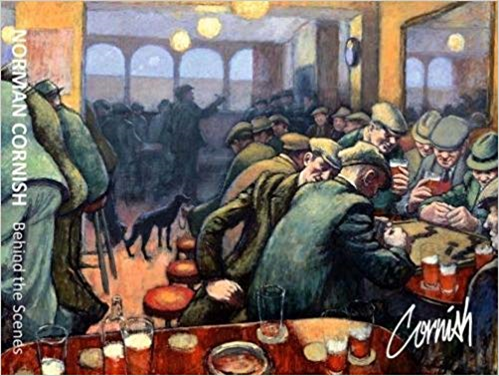
Figure 1: Cover of Thornton et.al. (2017): Detail of ‘The Crowded Bar’
However, a first visit does more than just whet one’s appetite. The world of Norman Cornish is genuinely a lost world and with all lost worlds its facts lose definition in memory and promote mythologies and legends. Some of those are less helpful than others.
It has taken me a long time to like the images of rotund male bottoms swaying at bars. This once made me dislike what I saw (I think now totally wrongly) as a world of stereotypes that felt brazenly harmful and prejudicial; trading in fictive reductive images of working-class men as in the contemporary phenomenon, Andy Capp. Today I began to see these differently. The classic example which I once generalised as representative of his work is The Crowded Bar, here represented in fig. 1 from a detail used as a book jacket (but the wonderfully large original is in this exhibition).
Now this picture probably needs no defence but it feels still to me as externalised and objectifying as I always thought. Its achievement owes much I’m guessing to a desire to outdo Van Gogh’s images of the bars in Arles – technically if focuses on light and emotion. Cornish himself felt that the round globes in the bar, brilliantly reflected in both the window behind them and a mirror to the side were what he himself admired here. Rightly, though that is because he uses the shape of these lights to understand the overall lighting of his scenario. Only the figures and setting of the foreground mark the round light above the back of the man in a green jacket playing dominoes and reflected in that jacket. It is otherwise unseen than in reflections: on the sheen of that jacket and the polished table at the bottom edge of the window frame, for instance. This table fixes the position of the viewer looking up (as if seated) from behind that table and equated with viewer of the picture as a whole.
The round light accurately lights what is immediately in the picture foreground but also darkens relatively the background as it proceeds to the external window. This low angle of vision looks up at the men leaning at the bar and directly only at the faces of men seated. This angle of vision is the reason for the prominence of the male bottoms in this picture. The one on the extreme left of the extract reflects back the same round light as we have seen elsewhere reflected on table and male back on the right. I love these effects but cannot see their meaning other than as a picture of working-class men as simple consumers – its iconography limited to the beer levels in the different glasses and the body size of the men. And I don’t know what to make of this effect, except that this is a wonderful picture of how time is spent and used. These men are not men who actively think or act purposely.
Contrast it with a picture I find immediately fulfilling and energetic, full of men who act, talk and think. These may wear the same flat caps but they aren’t stereotypes. This picture is The Busy Bar.
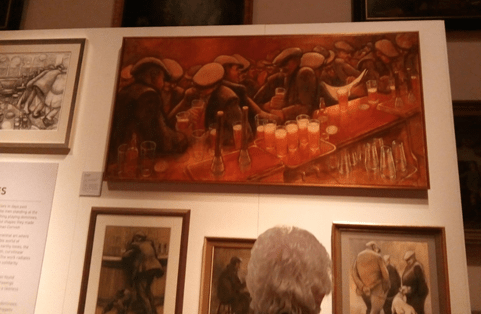
The angle of vision here is downwards, as if from someone standing behind the counter of the bar. Although consumption occurs, it is an adjunct to visible interactions between the men. The exchanges occur through opened mouths in speech, variegated expressions, gesture, attitude. Of course there is slumping and leaning but it is musically counterpointed by other gestures and activities including engaged co-consultation of a paper. The Spennymoor Cornish knew was not one in which men used time-off in consumption pure and simple but, also through the Spennymoor Settlement Movement in education, discussion, reflection ( McManners & Wales 2002:85ff.) . The working-class movement is in The Busy Bar, if not in the Crowded Bar, a focus of active engagement with the world not passive consumption.
Of course these readings are subjective – based mainly on a contrast of angle of vision. One aimed at the level of men’s backsides reducing men to these fundament(als), the other focusing on heads, faces and exchange. It would help if we knew the different conditions in which these paintings were made, even the date of making. However, few of the pictures in this exhibition are dated except by inference. For instance one of Sid Chaplin is thought to be of events we know to have happened in 1951.
Both bar paintings examine light and reflective surfaces, as Thornton et.al. (2017:81) have told us. Even faces can become such surfaces. In both a lot of effort is given to ensuring that the reflective capacity of glass, or even polished wooden surfaces, is captured as is the distortion caused in looking through transparent glass, with or without fluid in them. But the difference in overall emotion of each picture is caused by differing effects of form, masses, space and colour.
If The Crowded Bar emphasises a kind of emptiness in its centre (occupied only by two dogs), akin to the empty buffets worn down by countless posteriors, it is because these men look only at things not at each other. They use things. In The Busy Bar the only empty space is that of the reflecting counter, but that too is part of a process of motion , with glasses empty ready for use seen by the viewer not the men, glasses of beer being or partially consumed and a full tray of filled glasses ready for distribution. The diagonals of the counter squeeze the men into what appears as inadequate space but that space is softened by the warmth on the base colour of this monochrome – a warming urgent and variegated red-ochre. These two paintings show, I feel, variant forms of male communion and togetherness – they contrast isolation (even in crowds) with a busy communal sociability. In that sense they paint the social in the form of feelings and thoughts. This is why Van Gogh seems to me such an important figure.
Let’s take this further by looking at Pit Road with Telegraph Poles (1947?). Thornton et. Al. (2017:8f.) have examined studies in the sketchbook in ways that have definitively tied this meme in Cornish’s paintings with the artist’s interest in Van Gogh’s The Starry Night.
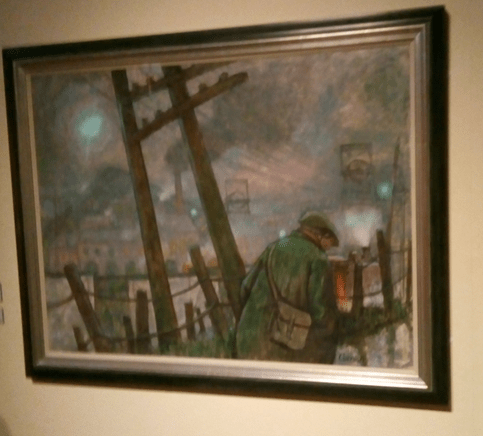
Some of the colour studies experiment even with Van Gogh’s own colour schemes. However, Cornish’s men, seen from behind tramping to work, often seem to exemplify isolation. In contrast, his setting in this painting with its contrasts of light dark, infernal and redemptive colouration and even the well-known icon of the Cross[1] represented in falling telegraph poles tell us that isolation is set against other alternatives. His millennial landscapes are often an inferno but as often potentially the promise of a Paradise (if never ever a realised Paradise).
For me this shows the cognitive-affective depths of Cornish as a mythmaker. His aim is not to show the working class for what it is or has been made to be by others but all the things it can be, for good or ill, if it finds its own road. These are in this widest sense political paintings but political only in the form of the legendary and mythical.
But if that is so, it isn’t easy to read off them a political message. Northumbria University’s oil, Pit Gantry, is an amazing picture which exhilarates and saddens.
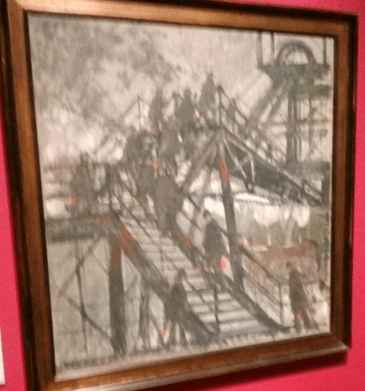
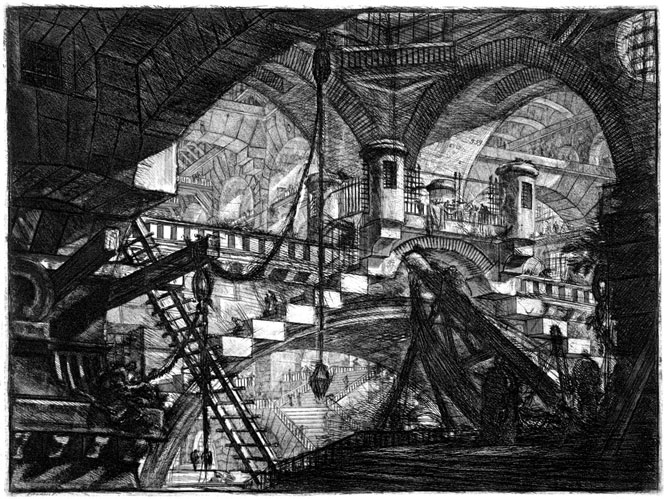
People may be reduced to ciphers, oil paint to brush-marks resembling pastel but the overall effect is to set the weariness of the gantry ascent against high levels of exchange of energy, in which the scaffold causes the eye to climb the gantry as in a Piranesi Carceri sketch. The counter-pointed motion in colour, light and smoke can only be seen in the original but is thrilling and not at all depressing.
Of Cornish’s pictures of the working class in domestic social settings, I find comment difficult and I need to see them again (and again).
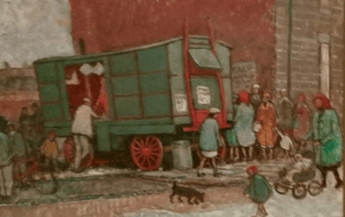
Berriman’s Chip Van is as located a picture as you will ever find. We can know the place where that van was allowed to park, we can see the people who used it – the sales window though being turned away from us and the queue obscured. What strikes me most though is the raised trap, in the same colour as the van’s wheels, at the centre of this detail, and the painting, which indicate the absent horse that made, and will make again, this van mobile. All these forms are marked by obvious colour and tonal contrasts of basic reds and greens.
For me it remains a picture of how the social is built on things that transform in time, even down to the waste bin for the fish-and-chip papers. This van comes and goes by rota and when gone its place knows it not, not, at least, until it returns with its trans-formative social effects.
The truth is that I don’t understand Cornish yet. This exhibition and others (Palace Green & the Mining Art Gallery) will make this possible up to next January.
[1] Cornish showed Christ on Crosses that were telephone poles in many sketches (Thornton et.al. 2017:10f.)
 Steve_Bamlett_blog
One thought on “Looking Back to Cornish – the retrospective at Bowes Museum visited 16th November 2019.”