For more on Loach & Laverty: https://stevebamlett.home.blog/2019/12/04/was-social-justice-ever-easy-ken-loach-and-paul-laverty-at-the-newcastle-literary-and-philosophical-society-4th-december-2019-12-30-2-p-m/
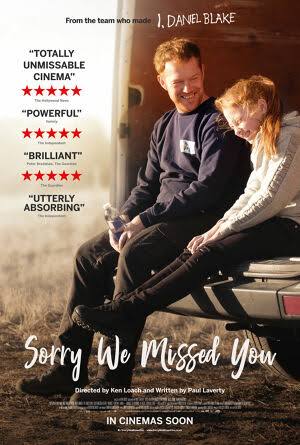
Ken Loach’s Sorry We Missed You – a difficult watch. In cinemas NOW.
I wish I hadn’t seen this in the midst of a General Election. Unbearably painful, it watches a family in a downward spiral that is entirely the effect of the deregulated capitalist political and economic system, which only the current Labour Party rejects and will, if elected, change. But in a General Election you see the forces against you – either willingly or ignorantly happy to maintain things as they are. The middle class ‘moderate left’ have been seduced by Remain-in-the-EU false paradigm of political hope such that they have been enabled to express their distaste to anything that looks like radical socialism. And only radical socialism can now halt the stride of deregulation and the ongoing push in deregulated capitalism to make working-class people bear all of the costs of economic, human, social and ecological instability. We know this family cannot escape and the film even refuses the planned or accidental death of its hero that it prepares us for – because that would suggest a resolution.
There is a possible resolution: in this election that solution is an option, but sometimes the resistance to social change makes a drama like this look like a demonstration of the inexorable forces of a drama by Aeschylus.
However, this would be so even where there not an election at the moment. The GIG economy looks set to thrive without real political change such as that offered by Labour currently: even our own behaviour as consumers looks set to maintain the disregard for the rights of workers this film puts as an invisible heartlessness at its centre. It is appropriate to awaken our guilt for being concerned as one character puts it, only that we get our ordered items in quick and regulated time. However, the Fates of this drama are not born out of individual but systemic forces – in which time and space are as commodified as the objects carried in and across them. The object (my book on Gender awaited at my house on the return from the play – possibly delivered by PDF) arrives in timely fashion only because we have bought at the cheapest price possible those qualities of space and time, drawing the surplus cost of achieving those qualities from the labour of the under-remunerated and under-supported.
The family drama in the film has a taste of Greek tragedy. Sebastian (Seb) is a son whose artistic talents, like those of Orestes and Electra, are hidden under behaviour seen as wasteful, abnormal and dangerous. He must pay the cost, a policeman says, of having a caring family by not pursuing any self-distinction. The materials of his art are gained by pawning essentials to life or petty theft, and only after tragedy does his father sense that his son is asking questions that are not being heard.
And everything in this over-commodified economy is sparse as a result of unequal distributions – from access to healthcare and queues in Emergency Departments, chances to ‘graft’ with genuine autonomy, and produce meaningful art and offer personal care to others. The care system is a central part of this film – with its cast of people made vulnerable, not by disability, but by lack of access to appropriate care that might give them a life equivalent to the ‘enabled. I’ve seen these processes in operation. Dignified ladies who become horrified of their incontinence, because they no longer have control of the means to continence, and young people with learning disabilities who must face a wasting-life of utter and inactive lack of meaning because they need to pay for activity, like getting up from bed, others of us think of as free.
If PDF were a real firm, would its managers be as clear about their status as hard bastards as is the wonderfully-acted character in this film! But, of course, PDF is a real firm – it is a type that has many various token manifestations, each of which demand of their management personnel that they turn themselves into monumental ‘hard bastards’ – turned into stone not by art but by what seems NECESSITY, as in a Greek tragedy. Creon in Sophocles’ Antigone is explained in much the same kind of way
This is a very great film. I do not know if I dare see it again. The forces of catastrophising it releases are not easily handled. By some, they may not be handled at all. Typing this was a necessity of handling it for myself.
But see it. If I could I’d force everyone to see it – before they even think of casting their vote. It is Ken Loach at his very best.
 Steve_Bamlett_blog
One thought on “Ken Loach’s ‘Sorry We Missed You’ – a difficult watch. In cinemas NOW.”