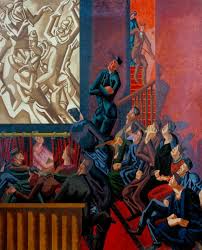
For Bomberg being ‘Partizan’ took the self-identifying form of the masses representing the Jewish diaspora. Bomberg’s criss-cross-patterns ‘over the surface of a page’ represent the violence and excitement of diaspora Whitechapel as much as stylistic innovation focused upon by a Leeds City Gallery curator.[1] Jewish Theatre (1913-14) is ‘a violent image’,[2] eschewing ‘harmony’ and ‘unity’ in favour of a crowd that self-implodes.

Ghetto Theatre (1920), however, is nolonger violent,and assembles crowds in parts, split by imposed criss-cross barriers of class and ethnic experience. Both study and painting ‘celebrate’ Whitechapel’s Pavilion-Theatre, providing classic plays in Yiddish to East-End Jews.[3] Yet in both the image nearest to an artistic motif, that scene played on the stage, is occluded – we look towards the emotion of the ‘crowd’ not artists-on-stage creating images. The gaze of the painting’s viewer has no clear place from which to imagine its unitary focal-point or stance. Unlike the divided crowd of stalls and gallery, viewers are not given a space in which to stand and be recognised. Suspended in the theatre-void at a level above its gallery, we look down on both floors holding in and containing these ‘massy’ volumes.
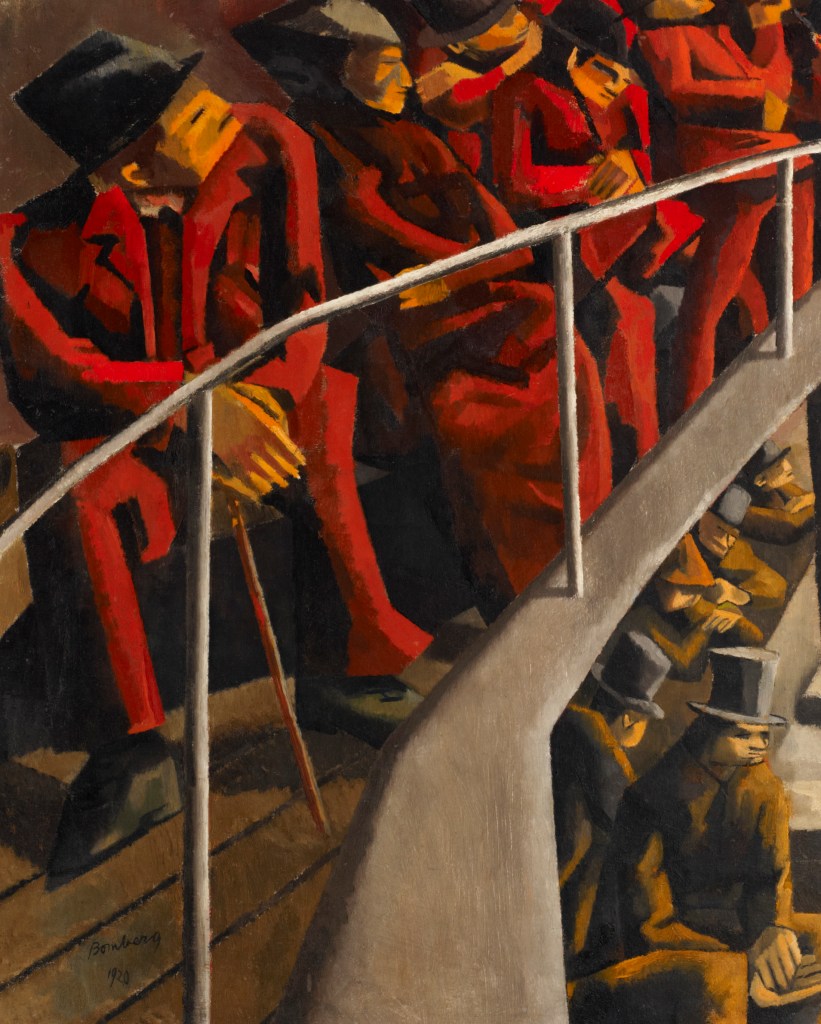
Their mass-gaze is itself multiply dispersed. No figure seems to look at the same thing; many seem vacant or inaccessible. Their eyes represented by slashes of shadow of varying thickness, none of them look at us. Any ‘represented’ floorboard-space is inaccessible to us and converges on the figures within the painting to give that sense of ‘compressed space’ noted.[4] Bomberg’s theatre-crowd fills space that holds it in. For the viewer, the act-of-looking is similarly constrained by the effective dominance of the irregular rail, which pushing onto the picture-plane, feels too proximate. The sensation is of both vertigo and claustrophobia. By 1920 then Bomberg’s theatre-crowd has changed from 1913’s revolutionary energy-blast to being symbolic of enclosed repressed-energies. There are deep similarities in Roberts’ work: The Cinema (1920) is a companion piece, with telling differences. However, this selection of British paintings, represents crowds (and ideas of multiplicity, diversity, partiality, and oppression, they themselves illustrate). They challenge Fry’s view that artworks are not necessarily representative of anything other than art itself; autonomous of political-life and engagement. Choosing images that engage politically and socially helps avoid needing to look too harmonious and unified. But this is complicated by the largesse implied by the idea of an art of multiplicity-and-diversity, especially at level of sociocultural politics. This painting-set demonstrates not only similar internal multiplicities and diversities within each painting but also interactional ones between them. In Bomberg’s case, for instance, the selection was driven by his particular interest in the crowd as a phenomenon of the Jewish diaspora. However, the motif in Ghetto Theatre is allied to Roberts’ At The Hippodrome (1921), since both illustrate segregated crowds. Yet Cinema’s reflective take on working-class cultural energies compels.
[1] This study can be seen in Leeds City Art Gallery (Leeds u.d.:Sec.VII)
[2] Ibid.
[3] Dickson & MacDougall (2015:55)
[4] Ibid:55
 Steve_Bamlett_blog