Currently on show with Poussin Triumph of Pan, Trevor Gallery, Bishop Auckland Castle, Auckland Project: Francois B. Perrier Narcissus & Echo
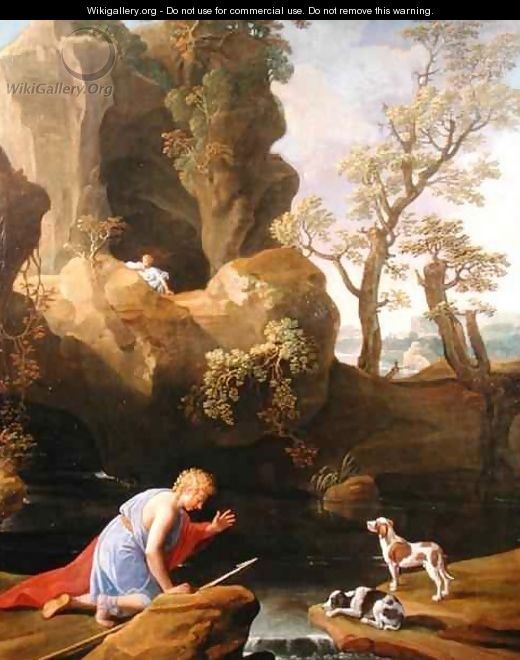
Thought to be near contemporary to The Triumph of Pan by Poussin, this painting is used to illustrate seventeenth century uses of mythological narratives or scenarios that illuminate Poussin’s context. For me the chief virtue of seeing both is their common use of a moralised landscape to illustrate the allegorical and/or symbolic narrative scenario.
In this scenario, the composition is segmented, the bottom third representing the central scene in which Narcissus catches with joy first sight of himself. The reflection is hidden from us by an obtrusive rock jutting up from the picture frame, although further back in the pool another rock does enjoy its own reflection. Narcissus is surprised presumably during a hunt, as declared by his spear, now in relaxed state, and the hunting dog, who has gone to sleep. The other dog however looks up, his ears caught by sound. His gaze goes up towards Echo, who languishes in another segment of the composition.
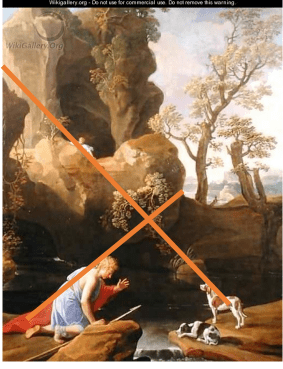
The latter segment fills the top two thirds of the left of the picture. It, like the last section, is rocky and full of shadows cast by them. Most shadows fall in a dark halo around and behind Narcissus, morally pointing to the darkness he here plays with. In the Echo segment, shadows are less dark and emphasise form in a way that sensualises it. Echo is the neglected female, as neglected by Narcissus as the hunt he has abandoned. My untrained suspicion here then is that Narcissus is critiqued for the folly of self-obsession and capture by male, rather than female, beauty.
The sensualised rocks around Echo clearly mimic the echo chamber of the ear but may also symbolise the vagina and reproduction. The rock is surrounded by young vegetation, even above the head of Narcissus, who does not look at it. It is the source of the running water, in the temporary stillness of which a pool is formed in which Narcissus finds his beloved image, regardless that the water continues to flow through it and the cleft at the bottom picture frame. The female brown spotted dog knows that and looks to the sound caused by the echoing cave rather than sadly to the bewitched Narcissus. Irrespective of either the final, top-right segment is open and full of light, backgrounding more life, even that that comes from a stunted tree, although more fully by the arch of the growing tree. The scene is dissected by diagonal lines that emphasise moral elements. The central darkness, the right leaning growth. The left (sinister) sources of darkness and obstruction.
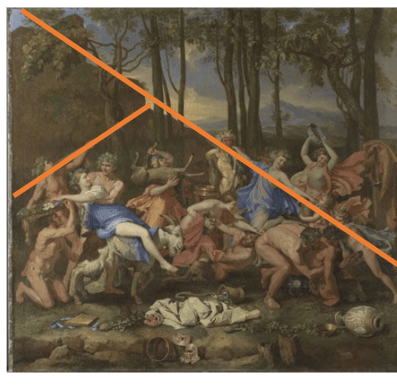
I have no doubt that the heteronormative in this picture is intriguingly held back by the beauty of the main scene, which may more enchant the viewer (all appearances) who does not listen to the sound of the echoing moral. Chiaroscuro is moral where the notional lines I draw above on the picture intersect.
How might that help with Poussin. Poussin too draws a moral line with landscape and human bodies in his final painting. We can look at that first. The obvious dissecting lines which Poussin draws attention too are seen here. A romantic-cleft leans to the sinister left colluding with the action of naked flesh – the arm-frame of the nymph and the back of a boy-wanton being central but are extended by the cleft of the rock. There is a hint of dawn in the remaining landscape – light coming from the east that might surprise this company in their gloom.
The moral issue is more complex here. There is no clear distancing from the sybaritic joy depicted, except that classical vessels are overthrown. The hunt has already happened and its animal prey hangs down from the shoulder of a sybarite. The wealthy young man who has now cast off a toga-like robe is now naked except for bells at his ankles. His gaze is absorbed in a mesh of animal-human limbs (a goat-bottomed satyr is at its centre) between himself and the wanton boy which seem to both expose without making visible the phallus of the central creature. We cannot make out what is happening to non-visible hands here.
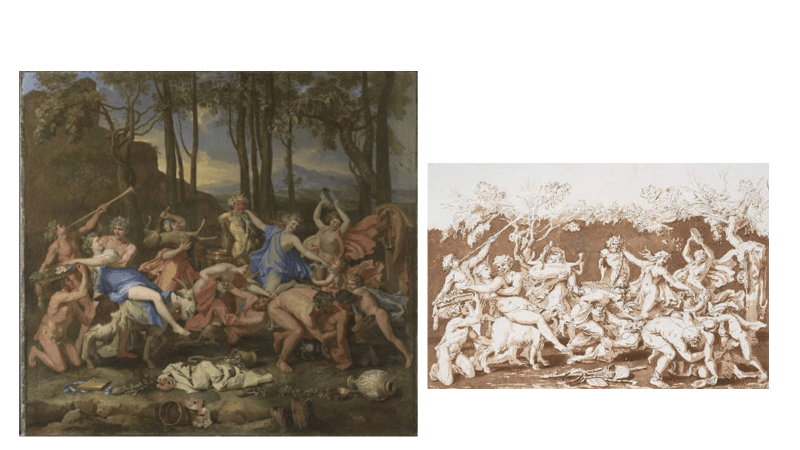
This is a much more complex moral landscape than that in Perrier but I do believe it could be a ‘paysage moralisé’ in the way. In the same room, loaned from the Queen’s Collection is a late sketch, but note how that is a mere theatrical scenario, ignoring much that, I think, moralises the scene, including the vast stretch of landscape nature and the rocky precipice over which the scene teeters.
Below I position them to show the partialness of the late study and its conventional framing. The final painting is much more demanding. I need to think much more what the scene means or might mean. It has, for instance a lot to say about how the Baroque artist conceived the differentiation of male and female flesh.
 Steve_Bamlett_blog
3 thoughts on “Bishop Auckland ‘Triumph of Pan’ exhibition Visit (2) Perrier’s Narcissus”