Developing a research topic: Working up to TMA05 A844
- What is the working title of your dissertation (initially formulated as a question)?
Following feedback on TMA04:
- How can Vaughan’s Assembly of Figures paintings be seen as the efforts of a gay artist to negotiate expectations of the purpose of art within post-war British painting?
New Rethink (possible – to check with tutor):
- Referring to Keith Vaughan’s Assembly of Figures series of paintings as exempla, how do dynamics that structure the concept of the homosocial in post-war England up to the 1970s relate to the ways Vaughan negotiated expectations of mid-twentieth century art by gay male artists?
- What are your key underlying questions and themes? And (inset):
- How will these address the question in your title?
- How is the range of ‘expectations of mid-twentieth century art by gay male artists’ to be calibrated?
- The focus will be on the definition of the Euro-American and English Neo-Romantic movements by James Thrall Soby (After Picasso 1936) and, arguably, John Lehmann and Raymond Mortimer respectively.
- These movements, initially focused on Moore and Sutherland in England began to revolve around literary-visual art in Lehman’s Penguin New Writing, for whom Vaughan was on the payroll, and its later offshoots.
- Of the ‘younger’ members of this group, Minton, Craxton and Vaughan (and the art impresario Peter Watson) were gay. The myth of the ‘Homintern’ (the idea of a powerful gay male elite liked to the Soviet Comintern) and why it subsists.
- Cite evidence that Vaughan, in contrast to Craxton and Minton, was difficult to place in the 1980s Neo-Romantic retrospectives[1] because of a perceived failure of imagination attributable to ‘a homosexual plan, of flat, bulky, male torsos’.[2]
- The terminal date of Neo-romanticism is debatable but most commentators agree that Vaughan tired of it well before the others. He gave an authoritative description of the ‘group’ in 1944.[3] His project to ‘tend the male body’ from the 1950s is seen as divergent by Mellor.[4]
- The ‘male body’ is characteristic described in groups after the Neo-Romantic period rather than isolates or dyads. Analysis of the assembly paintings follows on
- Why is ‘the dynamics of the homosocial’ an important social context and how can it be described, analysed and critiqued?
- The defining approach to cultural history (in all senses of the word ‘culture’ pace Raymond Williams) is through the work of Eve Kosofsky Sedgwick, which itself builds on the notion of the ‘performative’ in Butler (build from A843 Block 1). She is a feminist theorist to whom the development of ‘queer theory’ is oft attributed.
- She defined the ‘homosocial’ in Between Men (1985). The key later text though is The Epistemology of the Closet (2008 revised ed.) in which she defines the dynamic structuring power of the invention in the nineteenth and early twentieth century of the homosexual/heterosexual binary in which the second term is the privileged term.
- This ‘binarism’ accesses many allied others including female/male, sentimental/anti-sentimental (a key one for my explanation of the shift out of the Neo-Romantic movement) and figuration/abstraction (based for Sedgwick in the discussion of art in The Picture of Dorian Gray). All these terms are of theoretical interest and have explanatory power in terms of Vaughan’s shift from Neo-romantic to ‘assembly’ studies of the male ‘body’ (as the assembly of an individual and/or group). Of course explaining this will take a lot of expressive struggle yet to come.
- Why did Vaughan fixate on the term ‘Assembly’ and Assembling? This will mark the entry of the performative as ‘speech act’ theoretically and the analysis of assembly as noun or verbal form in Vaughan’s titles and their correspondences in the way in which Vaughan said he would ‘think and act and feel in paint’ (Journals) at the level of figuration, composition and dynamism in the painting process and the link to the queering of the male subject.
- The relational ideas of foreground/background and the significance of interstices between figures in these paintings.
- Which artist(s), work(s), debate(s) will you focus on?
Mainly on Vaughan although with reference to other gay artists (Tchelitchew, Minton, Craxton, Colqhoun), art patrons (Peter Watson) & entrepreneurs (John Lehman in particular).
Debate about the definition of the ‘homosexual’ and the role of the state and allied institutions (in health for instance) in the regulation of sexual desire and / or its expression (Jeffrey Weekes of course) but reliant on critical reading of Kosofsky Sedgwick.
What might you analyse in your dissertation?
- Vaughan’s paintings that work from studies of male homosocial groupings (Laocoön, Martyrdoms, Crucifixions – Kosofsky Sedgwick (2008: c151) useful here. The Nine Assembly of Figures paintings and other pictures that exploit the verbal/nominal pun on Assembly.
- Comparison Minton (Death of Nelson)
- What might you evaluate?
- The theoretical framework described and used from Kosofsky Sedgwick and other theorists (queer theory and performative theory).
- The paintings comparatively especially in the shift from the period of Neo-romanticism (the illustrations for Rimbaud’s Season in Hell for Lehman for instance) to the early assembly pictures. Early figurative to more abstract later assembly/assembling paintings.
- Vaughan’s public and private writing on art and artists (Sutherland, Klee, Minton etc.90
- What might you critique?
- Theories of artistic groupings such as Neo-Romanticism (and more radically modernism).
- Theories of sexual identity /orientation as oppressive to gay men, women and other LGBRQI+ groupings.
- Readings of Vaughan in the extant criticism – a very balanced look at strengths and weaknesses Gerard Hastings as the major contemporary art historian working on Vaughan and his publications, co-publications and involvement in exhibitions (attending his talk in London on May 12th 2019).
- What A843/A844 themes/critical theories will you engage with and how will this be done?
- The treatment of performative and queer theory in Block 1 A843. The concentration on ‘homosexual identity’ as the focus for debates in this are throughout A844. The absence of the issue re Elmgreen & Dragset.
- Is your topic primarily object-based or issue-led?
- It is combined but I perceive it as primarily engaged with a specific set of objets d’art (the Assembly paintings).
- Provide a summary of your enquiry in one short paragraph, including a brief explanation of the value of researching this topic.
- Vaughan was first encountered amidst a grouping of painters labelled the Neo-Romantics, many of whom were gay men) and this conflation occurred to the 1950s during which he was allied to these painters as friends, housemates, employers (Lehman), patrons (Watson) and so on. This period set expectations of art described as Neo-Romantic. For Vaughan they focused on the isolate male body or dyads of male body (parts) especially hands. His mature art is based on the development of a subject and ‘style’ that can be described as made up in the manner of an assembly. He used this term in his titles. The work on this has been started by Hastings but needs elaboration and contextualising in theories of queer cultural and art history, using an extrapolation of Kosofsky Sedgwick and others (Katz?).
Methodology/Engaging in a discourse
- How would you characterise your methodological approach? (i.e. a social historical enquiry/analysis, a historiographical survey, theoretical critique etc.)
- A social historical enquiry/analysis informed by a queer perspective.
- What is your position in relation to current scholarship on your topic?
- Critical of positions based on Gay identity politics solely and embracing the notion that the construction of the homosexual was a by-product of the construction of the heterosexual and the binary oppositions that defined this term and linked the homosocial to the homophobic. Hence a movement on from the dominant appearance of theory about gay artists in A843.A844. I don’t need to include this unless it is a requirement of the mark scheme that the course material is directly addressed.
- Who do you agree with?
- Who do you depart from?
- Located in extrapolations of queer theory as elaborated by Eve Kosofsky Sedgwick.
- Engaging in analysis of paintings and texts on art and queer by Vaughan
- Aware of strengths and limitations (but mainly the latter) in Gerard Hasting’s work, which is ongoing. I am attending a talk on his latest project on 12 June 2019.
- What critical position do you hold in relation to your topic?
- The establishment of a queer theoretical framework for the discussion of post-war art by gay artists. A queer understanding of the non-parochial importance (that is, not limited to one community) of that art.
- Can you identify any inconsistencies/conflicts/tensions within your area of enquiry that can be interrogated/resolved/debated?
- Issues of gay male identity and self-evaluation are important in discourses of sexuality in the period (as generated from concerns about the triad of Oscar Wilde – Walt Whitman – Edward Carpenter) but are essentially not a sources of value in discussing or elaborating a notion of gay art.
- Queer art has more purchase as a social critique of a society that sustains homophobia as a necessity of understanding the constitution of powerful (and even less powerful) homosocial groupings.
- Nevertheless these views are in tension in practice in the discourses available to gay artists of this period. Do they elaborate coded identities or do these codes enable audiences to estrange themselves from norms (especially heteronormativity) otherwise strongly established in the society of the day (and today I’d say). Does this art have relevance to audiences other than gay male ones? Does it have relevance to women? (The latter is much more problematic and may be a topic in its own terms and therefore unsafe for the purpose here).
Sources
- What are your key primary and secondary sources from the module(s)? – set books, module materials
- Primarily Module 1 of A843 on performativity and gay theory. Other passing references in A844
- What are your key primary and secondary sources from outside the module(s)?
- As in bibliography plus footnotes
- Are the sources accessible?
- The full journal of Vaughan is, in part at least available online from its curators at the Tate but parts are formally published. I have a personal collection of Vaughan materials – catalogues, books and more are available through libraries.
- How will you use these sources?
- To make sense of the paintings and primary texts on art from a queer perspective.
- What visual material will you use?
- Examples below with links.
| 1 | Martyrdom of Saint Sebastian, AH281 (1958)Oil on hardboard 88.9 x 120.7 cm. Bradford Museums and Galleries. Available at: https://artuk.org/discover/artworks/the-martyrdom-of-saint-sebastian-23516 (Accessed 27/04/19) |
| 2 | Assembly of Figures, AKA First Assembly of Figures, AH129 (1952)Oil on board 142.2 x 116.8 cm. Sainsbury Centre for Visual Arts, Norwich. Available at: http://www.thekeithvaughansociety.com/2016/11/24/first-assembly-figures-1952/ (Accessed 27/04/19) |
| 3 | Eldorado Banal – Ninth Assembly of Figures (1976) Oil on Canvas 114.3 x 152.4 cm. AH594 Tate Gallery Collection. Available at: http://www.thekeithvaughansociety.com/2016/11/17/ninth-assembly-figures-eldorado-banal-1976%E2%80%A8/ (Accessed 27/04/19) |
| 4 | Crowd Assembling II (1968) AH484 Oil on canvas 101.6 x 91.4 cm. Private collection. Available at: http://66.media.tumblr.com/1fa94da19ae4941a0ff98c9365aa9925/tumblr_mvenbpKUfo1rvpbxco1_1280.jpg (Accessed 27/04/19) |
Planning the dissertation
- How will you structure your dissertation? (Chapters, sections – and how many?)
- Chapter 1: Introduction:
- Queer Theory, Art and the Historical context in which gay artists painted focusing on post-war art from the group originally known as Neo-Romantics.
- The focal paintings and why they were selected
- Chapter 2: Male Nudes or Male Nude Groups
- Chapter 3: The Challenge of Male Assemblies: Art as Process
- Chapter 4: Conclusion. Return to queer theory. Is it supported as a way of understanding Vaughan’s dilemmas as a gay male artist?
- What will be the approximate word count for introduction, chapters/sections, conclusion?
- 2000
- 3000
- 3000
- 2000
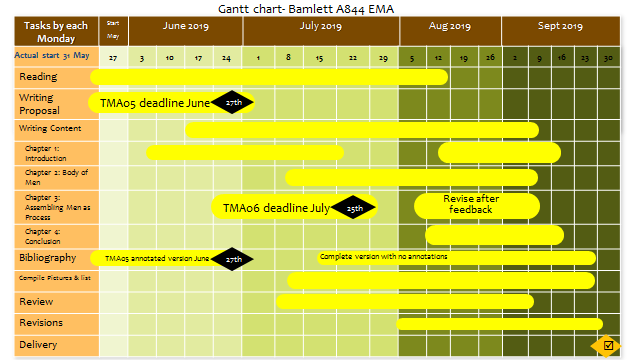
- What is your timetable for research and writing?
- Gant table to be devised as next task after talk to tutor
- https://stevebamlett.home.blog/2019/05/31/gantt-chart/
- Will you have an appendix? If so, what will you use it for?
- Perhaps for hard to find pieces from contemporary journals in which Vaughan participated.
Problems
- What are the main difficulties you think you may have to resolve in researching and writing the dissertation?
- Focusing such that theory serves the readings of primary texts and visuals and not vice-versa.
- Getting a clear take on complex theoretical discourses which employ literary techniques (Kosofsky Sedgwick can be a dense writer).
- Ensuring that readings of paintings employing internal evidence are justified and can be validated.
- How might you go about resolving them?
- Continual review of writing and disciplined use of introduction.
- Drafting, re-drafting, checking cogency of writing. Using my husband to read for clarity (poor Geoff!).
- Do both of these:
- Test readings for clarity and for visibility of internal evidence in reproductions. Guiding reader to detail through marks on reproductions if necessary.
- Use triangulated evidence. Test reading against contemporary primary sources, especially in Vaughan’s writing or that ibn literature we know him to have consulted (James Thrall Soby!) as art editor for John Lehman or otherwise.
Extended Bibliography since last time (Awaiting annotation)
Agnew’s (1990) Keith Vaughan: 1912-1977 Catalogue London, Agnew’s.
Austin/Desmond Fine Art (ud) Keith Vaughan: Catalogue of Paintings, Gouaches, Watercolours and Drawings 1936-1976 Sunninghill, Berks., Austin/Desmond Fine Art.
Austin/Desmond Fine Art (ud) Keith Vaughan: 1912-1977 Catalogue London, Austin/Desmond Fine Art.
Barber, N. (1964) Conversations with Painters London, Collins
Butler, J. (2011) Bodies That Matter: On the discursive limits of “sex” London, Routledge Classics Ed.
Clark, A. & Dronfield, J. (2015) Queer Saint: The Cultured Life of Peter Watson who shook Twentieth-Century Art and Shocked High society London, John Blake
Cruse, C. (Ed.) (2013) Keith Vaughan: Figure and Ground: Drawings, Prints and photographs Bristol, Sansom & Company Ltd.
Graham, P. & Boyd, S. (Ed.) (1991) Keith Vaughan 1912-1977: Drawings of the Young Male London, GMP Publishers Ltd.
Hastings, G. (2012) Drawing To A Close: The Final Journals of Keith Vaughan Pagham, The Pagham Press.
Hastings, G. (2016) Paradise Found & Lost: Keith Vaughan in Essex Pagham, Pagham Press.
Hastings, G. (2016) ‘Introduction to the Nine Assemblies’ in The Keith Vaughan Society Website. Available at: http://www.thekeithvaughansociety.com/2016/11/25/introduction-nine-assemblies/ (Accessed 27/04/19)
Hastings, G. (2017) Awkward Artefacts: The ‘Erotic Fantasies’ of Keith Vaughan Pagham, The Pagham Press with The Keith Vaughan Society.
Hepworth, A. (2007) Keith Vaughan: Figure and Landscape Bath, North East Somerset Council
Hepworth, A. & Massey, I. (2012) Keith Vaughan: The Mature Oils 1946-1977: A commentary and a catalogue raisonné Bristol, Sansom & Company Ltd.
Julian Lax (2000) Keith Vaughan: Catalogue of a Collection of Paintings, Gouaches, Drawings and Lithographs London, Julian Lax.
Lehmann, J. (1976) In the Purely Pagan Sense: A Novel Colchester, Blond and Briggs Co. Ltd.
Martin, S., Butlin, M. & Meyrick, R. (Eds.) (2007) Poets in the Landscape: The Romantic Spirit in British Art Chichester, Pallant House Gallery
Mellor, D. (1987) A Paradise Lost: The Neo-Romantic Imagination in Britain 1935-55. London, Barbican Art Gallery
Middleton, M. (1948) ‘Four English Romantics’ in Lehmann, J. (Ed.) Dust Jacket by Keith Vaughan Orpheus: A Symposium of the Arts London, New Directions 1948 pp.107-113. One of the 4 is Vaughan
Moore, J.N. (2007) The Green Fuse: Pastoral Vision in English Art 1820-200 Woodbridge, Antique Collectors’ Club.
Newby, P.H. (1947) Illustrated and dust wrapper by Keith Vaughan The Spirit of Gem London, John Lehmann
Salisbury, M. (2017) The Illustrated Dust Jacket 1920-1970 london, Thames & Hudson.
Sedgwick, E.K. (1985) Between Men: English literature and Male Homosocial Desire New York, Columbia University Press.
Sedgwick, E.K. (Updated Ed. 2003) Touching Feeling: Affect, Pedagogy, Performativity Durham, US & London, Duke University Press.
Sedgwick, E.K. (Updated Ed. 2008) Epistemology of the Closet Berkeley, University of California Press.
Soby, J.T. (1935) After Picasso New York, Dodd, Mead & Co.(Facsimile Milton Keynes, Lightning Source UK Ltd)
Tate film: https://www.tate.org.uk/art/artists/keith-vaughan-2096/keith-vaughan-under-skin
Turner, J.L. (2016) The Visitors’ Book: In Francis Bacon’s Shadow: The Lives of Richard Chopping and Denis Wirth-Miller London, Constable
Vann, P. & Hastings, G. (2012) Keith Vaughan Farnham, Lund Humphries.
Vaughan, K. Archive Papers in Tate: https://www.tate.org.uk/art/archive/tga-200817/personal-papers-of-keith-vaughan
Vaughan, K. (1944) ‘A View of English Painting’ in New Writing And Daylight Winter 1943-1944 London, John Lehmann. 87-96
Vaughan, K. (1946) ‘At the Klee Exhibition’ in New Writing And Daylight 1946 London, John Lehmann.
Vaughan, K. (1966) Journals & Drawings 1939-1965 London, Alan Ross
Vaughan, K. (1985) ‘The Way We Live Now’ in The Penguin New Writing 1940-1950 London, John Lehmann. 39-41
Vaughan, K. (2010) Journals 1939-1977 London, Faber & Faber
West, S. (2004) Portraiture Oxford, OUP (Ch 4 on ‘Group Portraiture’)
Woodcock, P. (2000) This Enchanted Isle: The Neo-Romantic Vision from William Blake to the New Visionaries Glastonbury, Gothic Image Publications.
Wright, P. (ud) Keith Vaughan on Pagham Beach: Photographs and Collages from the 1930s London, Austin/Desmond Fine Art.
Yorke, M. (1988) The Spirit of Place: Nine Neo-Romantic Artists and their Times London, Constable
Yorke, M. (1990) Keith Vaughan: His Life and Work London, Constable
Wright,
A. (1998) John Lehmann: A Pagan Adventure
London, Duckworth
[1] Witness the 1987 Barbican Art Gallery catalogue to the show A Paradise Lost: The Neo-Romantic Imagination in Britain 1935-55. Mellor, D. (1987).
[2] Ibid:26
[3] Vaughan, K. (1944)
[4] Mellor, D. (1987:25)
 Steve_Bamlett_blog

One thought on “Keith Vaughan: Queering the Assembly?”