This book appears to me to the best of the tradition of a scholarly art-history without (and indeed taking great prudential care not to try) breaking any boundaries. It is a fine piece of truth-telling in the best scholarly tradition that employs reflexive caution wisely and well – particularly in making the reader as fully aware as one needs to be of the arbitrariness of history writing (whose issues Burke conflates with ‘art history writing’).
Personally I feel that the latter contains more problematic ‘choices and exclusions’ (not least in the definition of its ‘domain’ (as ‘art’) and in the selection of the canon of the noteworthy within that domain than does ‘history writing’ per se but the following still stands as though true:
- All history, and art history writing, involves making a narrative from fragments that can be picked up and discarded, then pieced together in myriad ways. (188)
No room here then for treating history as science (or even social science) or for driving home thinking about the nature of evidence as those domains have had to do so that it lies at the methodological heart of the subject, for which Martin Kemp seems sometimes to make a case. Burke uses this moment of reflexivity to insist that she has been careful to return from established historiographic narrative to analysis of primary sources. And I think she has done that and done it, to my amateur mind, very well indeed (this doesn’t pretend to be a peer review).
In some ways I was the surprised reader she posits on her final page – but in some others I was not. There is much here that comes as no surprise to anyone who has read even a little of the more recent scholarship – the defence of the hypothesis that both the male and the female idealised nude (each made up as a whole from numerous perfect observed parts) met masculinist ideology and denigrated ‘real women’. But these ideas are followed through with both caution and without the heavy hand occasioned by the exclusive use of older historiographic tools like the concept of the ‘male gaze’ from Laura Mulvey (18f.). As for ‘real women’, Burke gives the debate about their presence some important and nuanced consideration (127ff.).
What I though new and exciting was the new (to me at least) way that the Renaissance interest in androgyny is reframed (131, 136f.), the cautious placing of the shift to a conception that ‘beauty’ was the one thing in which women excelled compared to men (132) from ’around the 1510s’, and the shifting ways in which nakedness in men acquired complex (and sometimes contradictory) meanings that moved from the signs of poverty to nobility. Even better are the discussions of shifting meaning, morphological preferences and desired visibility or otherwise of the genitals that even takes in a look at fashions in represented male underwear (41ff.). Best of all is the treatment of the role of art to inspire male physical desire in order to manifest the control over that sexual desire (and all other ‘lower’ things – like ones subjects, servants and ‘women’) that renders one part of the elite imagined by Ficino, the other Neoplatonists and Castiglione in The Courtier. I’d add Spenser in ‘The Faerie Queene’.
And Burke is right that this is a burgeoning subject. Hence I rescued these old blogs from a site which I’ve abandoned – it having abandoned me.
So what did ‘Raphael like about David’s backside’? (p. 150). Reviewing, from the bottom-up: Rubin, P.L. (2018) Seen From Behind: Perspectives on the Male Body and Renaissance Art New Haven & London, Yale University Press.
Monday, 26 Nov 2018, 19:16
Visible to anyone in the world
– Edited by Steve
Bamlett, Monday, 26 Nov 2018, 19:34
– Edited by Steve
Bamlett, Monday, 26 Nov 2018, 19:24
– Edited by Steve
Bamlett, Monday, 26 Nov 2018, 19:23
– Edited by Steve
Bamlett, Monday, 26 Nov 2018, 19:21
– Edited by Steve
Bamlett, Monday, 26 Nov 2018, 19:19
– Edited by Steve
Bamlett, Monday, 26 Nov 2018, 19:17
So what did ‘Raphael like about David’s backside’? (p. 150). Reviewing, from the bottom-up: Rubin, P.L. (2018) Seen From Behind: Perspectives on the Male Body and Renaissance Art New Haven & London, Yale University Press.
Rubin’s book isn’t a lot of things: it isn’t a development of queer theory although it references that theory well in Chapter 2 (on the ‘queer [teapot] pose in Eakins and his artistic forebears [50]) and Chapter 6, in particular, and in a more nuanced way. It also isn’t in any way an attempt to present a consistent thesis, other than insisting in the instances represented by 6 very different chapters the fact that there are competing visual-rhetorical modes, and sometimes literary analogues of these (I kept thinking of Chaucer who isn’t mentioned though Dante, of course, is), of the male posterior. Sometimes this involves female ones too, although Lucian makes it clear for one Athenian, at least, this is because her backside reminds him of Ganymede (44).
In the first chapter it is clear that at least three emotional domains in particular cover the posterior and these variously recur: disgust, humour and desire. Of course these interact sometimes but mostly we stay in many chapters with the latter, ‘the spectre of the ideal male nude’ in Chapter 6 being the best. Herein lies a source of thinking about how desire of the male for the male tied itself in with both historical ideologies of the masculine, homo-sociality and academic conventions, tropes and topoi – notably that of homosocial bathing. And here, at last we find a better example than Durer’s woodcut of an open-air male-bath: Domenico Cresti (or Passignano’s) Bathers at San Nicolo (1600) and the case for linking that and Michelangelo’s studies, the partial origin of all academic studies of the male nude (we are told), to a tradition that explains further what traditions Cezanne was both building on and breaking from in his male nude Bathers (1890). There are many examples of such long duration comparisons – they illuminate for instance the V-legged dorsal view of Caillebotte’s 1844 Man at His Bath. There are traditions of such a stance and migrations from its original meanings – in this case from masculine aggression in war from Pollaiulo Nude Man Seen from Three Angles (early 1470s) through David’s imperious Intervention of the Sabines (1799) to Bazille’s relaxed but manly Fisherman with a Net (1868) [113ff].
The fact that there isn’t a simple synthetic argument but rather six nuanced essays with common themes is a strength here. Thus the discussion of how multiple perspectives of the body seen all around from infinite viewpoints is beautifully tied to conventional themes of Renaissance art. This includes the paragone (the competition for priority) of art and sculpture and then gently inserted into the practices this set up – finishing nude bottoms perfectly even when designed (p.180ff.) for a collector’s inset wall-niche (where that bottom could not possibly be seen). Only in the chapter following this is this convention art-historical discovery segued into issues that queer the clarity of our statements about our ‘love’ of art. Comparing the ‘justification’ of an almost obsessive concern with the buttock in Cezanne with Michelangelo, she says (in a way that allows multiple unsaid motivations of artist or viewer to remain gelid in the air of both artists’ respective centuries):
Grandiose as they are, they lack the heroic motivation that had traditionally justified staring at men’s backsides. They threaten to make the viewer a voyeur (210).
Although the issue of humour isn’t explored in many later chapters, it fills Chapter 1 (the section called ‘Dirty Talk’ (p.26ff.)) and infects the prose so that every sentence sometimes seems to have a double-entendre or pun about the desirability of the ass, a bit like the one in my title or an exploration of why the butt of most jokes (visual and otherwise) is the butt – whether in a fourteenth-century Flemish parchment anti-clerical illustration or a Newton cartoon of 1797 (28f.).
There is much here that is just straightforward art-historical scholarship of the highest order (even with some of the tedium of exempla that sometimes involves) but there is also much that opens up new hypotheses about why male nudity cannot be conceived without the necessary dorsal views. And the book insists that this isn’t just because of artistic emulatio from Leonardo’s [130] Study of a Man Seen Behind (1503-7) to Rossellini’s [140f] use of the Farnese Hercules in Voyage to Italy (1954). The treatment of dwarf nudes is splendid (156ff) and telling and has a lot to do with the nude as something we handle – in reality or imagination (158). There is a lot to be gained from little dips into this book. For instance the narrative that links Pollaiuolo’s Battle of Nudes (1470s) to Signorelli’s use of ‘shapely buttocks’ as his ‘signature (42), especially in the incredible Figures in a Landscape: Two Nude Youths (1488-9).
There is more to say. This is a very good book indeed. Together with Anthea Callen, this has been a great year for re-thinking the male nude.
Queer theory and Interdisciplinary Histories: Callen, Anthea (2018) Looking At Men:
Friday, 5 Oct 2018, 20:29
Visible to anyone in the world
Edited by Steve Bamlett, Wednesday, 10 Oct 2018, 22:20
A queer approach to sexual preference labelling in art-history (Queer theory and Interdisciplinary Histories): Intermezzo. Reflecting on: Callen, Anthea (2018) Looking At Men: Anatomy, Masculinity and the Modern Male Body. New Haven & London, Yale University Press
Coming across this kind of excellent scholarly work necessitates a pause and reconfiguration in one’s thinking. This ticks many boxes for me.
First, it locates queer theory in interdisciplinary historical discourses – those namely of medicine, art-education, psychosocial norms, especial of masculinity class and race, although many more art-historical narratives impinge – issues relating to the definition of image and its relation to meaning (iconographic , naturalistic, conceptual and formal-historical), proportionality & aesthetic form and formlessness, ideologically contextual as opposed to positivistic theories of the ‘ideal’, notions of self, identity and diversity, the history of discourses of sports and war and, of course, the shift to a multi-disciplinary grasp of ‘anatomy’ in the nineteenth century.
This will be a necessary struggle for me however I begin to focus in on a topic, since the nude throughout the nineteenth and twentieth century requires this grasp of different disciplines which shape its meanings. But then so does ‘queer theory’ since it depends on an awareness of the specificities of the binaries which shape gender in any culture in space and time and the means by which these binary explanations of reality are established, maintained, challenged and survive challenge. The homosocial is made up from historical disciplines which in the nineteenth century mean things like the definition of concepts like ‘professionalism’ as well as normality and ‘appropriateness’ to norms. Of course however much I focus, that focus will be on a work, works, movements or artists or an artist but these questions will remain multiple ones and require attention, or, at least, awareness.
Callen’s book tries to look at the shift from the male nude as classical ideal (and the role of the Academies therein pace Edward Lucie-Smith) to naturalist ambitions to draw a statistical norm based on a theory of body economy (and its side-kick) efficiency which animated the work of art theorists and practitioners, as well as masters of male, health and physique and, of course, theorists of eugenic improvement.
She looks at works I see as central – Bonnat’s and Caillebotte’s nudes and briefly at Cezanne’s and other ‘bather’ motifs – but never really centrally to her argument. There are however very fine readings of paintings, whose importance I had not realised or guessed (or perhaps been even remotely aware of) such as Francois Sallé’s The Anatomy Class at the Ėcole des Beaux-Arts (especially in the brilliant reading that traverses pp. 130 – 139). Here class, the homosocial, age, profession, class, sexuality, envy and desire discourses intersect each other in a way that can ONLY be admired..
Yet love this book as much as I do, it sits and stares with a Sibyl-like stare at the dangers it flirts with of a discourse that doesn’t quite add up to a single thesis, however many fascinating (established and novel) arguments it sets running. I look sometimes for more links between the excellent historical writing and research – on the modes of capturing dynamic motion in photography for instance in science and art schools (a lot to learn here) – and the main tenor of the argument. Likewise the book keeps returning thinly to the representation of women in homosocial contexts in ways that don’t seem to have space to be made solid.
On the other hand some comparisons seem profound despite being met en-passant, such as the brilliant comparison of the labouring bodies of coal carriers in Gervex and Monet, for instance (179f.), whilst other art-objects definitely needed more definition (such as Dalou’s La Fraternitie from the 10tharrondisement Marriage Hall – the most perfect kiss (p. 181) between two male nudes I have ever seen (in art or out of it). I also wanted more awareness of just how ‘queer’ (antagonistic to norms) is George Lambert’s Chesham Street (1910) on p. 123 but little is said. This is an image everyone must puzzle over.
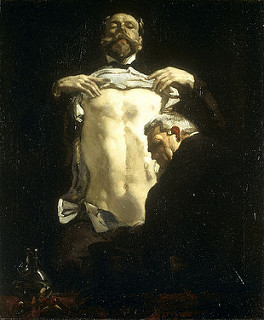
Queer theory often liberates from intentionalism and the ‘intentionalist fallacy’ but this is not the case when Callen speaks of Etty’s Wrestlers (a painting I love (p. 87)), which to me is full of much more ambivalence about ‘racial’ categories than she allows as well as normative mid-Victorian racism.
One of the most useful bits of learning for me is the role of the flayed nude écorché model, which links my interests in Titian and de Ribera to their fate in nineteenth century anatomical models – especially in holding up a light to the importance of living over fragmented dissected bodies in anatomical knowledge.
Anyone who loves a wonderful enlightening read will love this scholarly book because it is so well written, but to me it is going to cause a lot of headaches. Writing with, and distinguishing oneself meaningfully from, such excellence will be hard work. But that’s life. Thank you, Anthea Callen, art historian, thank you!
All the best
Steve
Comments
Tuesday, 6 Nov 2018, 11:21
by Anthea Callen (approved by Steve Bamlett, Tuesday, 6 Nov 2018, 12:10)
Professor
Thanks Steve, good food for further thought. There’s always more to do. You might want to check out my book The Work of Art: Landscape Painting and Artistic Identity in 19th-century France (2015, Reaktion), especially on Courbet and Cézanne, and the Intro. My Degas book (Yale 1995) focuses on the female material, here in Looking at Men I specifically shifted my focus to the male body and the male gaze on it. All the best, Anthea
Tuesday, 6 Nov 2018, 12:16
Thank you Professor Callen
I feel humbled by your comment. Your book has opened up so many doors for me. I will of course be checking out the rest of your work. Even where I feel challenged in my heart and soul, you express the point be considered so brilliantly and helpfully for me.
Thanks again
Steve
 Steve_Bamlett_blog
